Monday, October 16, 2006

Eating like a chicken

In the part of Nigeria where I was based for a while, if someone wanted to be really insulting, he or she would describe someone as eating like a chicken.

I was intrigued as to why eating like a chicken could be such a terrible insult and asked for the reason behind the saying. The explanation I was given was that a chicken never stops eating. From the time it wakes up until the time it goes to sleep, all it does is eat. If someone is described as eating like a chicken, it means that his or her life is consumed by an uncontrollable greed.

In Britain, if someone is very greedy, we describe that person as a pig, but that also implies that such an individual is extremely bad mannered and has no regard for the needs of others.

On the other hand, if someone is just very hungry and eats a large meal very quickly, they could be described as eating like a horse.

If you think of it, we use animals frequently in our everyday speech. We can swim like a fish, be as sly as a fox, as slippery as an eel, as peaceful as a dove, as timid as a deer and so on. Even Jesus used similar expressions in his own speech.

Why do we use animals in order to describe the behaviour of other people? Perhaps it is because we can watch animals and identify something we see reflected in those around us. Some of the behaviours are pleasant and even complimentary. I have no problems with being described as being as playful as a kitten or as peaceful as a dove. I don’t want to be known as a snake or an ass.

For some individuals, animals replace people in their lives. They find that they place trust in an animal that they would never place in another human being. Sometimes such people are just terribly lonely and have never learned to relate to others.

Some years ago, I was walking down a road in London, when I saw an elderly lady pushing a pram. I turned to see the baby and, to my surprise, saw not a baby, but a dog, dressed as a baby. At about the same time, I was nursing an old lady who was dying. When the ambulance crew had collected her from her home, they had found that she had more than 30 cats. She was going hungry because all her money was being spent on feeding the cats!

I really felt very sorry for the two old women. I think that they must have been very lonely people. An animal can never really replace a human being.

Similarly, nobody can replace God. No thing can take the place of God and give us real happiness. Some people try to put money, success or power in his place, but they never find happiness. Some of the unhappiest people I have ever met have also been amongst the richest. As the song says, “Money can’t buy me love.” If that is so, then why don’t we just fill our lives with the God who is love itself?


Lord, you made animals and love them, but people are more than mere beasts. You have given me the ability to think, to reason and to love. You have given me the ability to make choices. You give me the freedom to choose between right and wrong. Sometimes, Lord, people choose to love animals rather than people. Help me, Lord, to make the correct choice, the choice that will bring me closer to you. Amen

God bless,

Sr. Janet

Sunday, October 15, 2006

Words of a different sort

The little boy was quite angry as he tugged on his mother’s skirt to attract her attention as the bus left the stop this morning to head towards St. Peter’s. He was about 5 years old and was sitting on the knee of a girl of about 8. Normally, I wouldn’t have noticed the two children, except that when I saw them I had just realised that the group of adults surrounding them were all signing, so most, if not all, were deaf. What was fascinating about the little boy was that he showed, in his anger and frustration, that he is already fluent in sign language. His little fingers flashed backwards and forwards, leaving his mother in no doubts about what he was saying.

It was the first time that I have ever seen a child communicating through signing, and the first time I’ve ever seen someone express anger. It was every bit as articulate as using a voice! I sat mesmirised by his rapidly-moving fingers.

As the bus carried along the road, it occurred to me that, although he didn’t know it, that child had given me a gift this morning.

One of the four new saints canonised this morning had a great concern for those who could not speak or hear, so it was good to see that, as the Mass progressed, there was, alongside the Pope or whoever else was speaking, someone who gave a simultaneous translation for the deaf. Amongst the crowd of many tens of thousands, there were others who, presumably, were doing a translation into English, Spanish or French. Since I was myself doing the English commentary for Vatican Radio and Vatican Television, with my colleagues doing likewise in Spanish, Portuguese, French, German and Italian, it was intriguing to watch a completely different type of commentary taking place in St. Peter’s Square.

This evening, there are huge crowds of people across the world celebrating four new saints. Me? I freely admit that my greater joy was found in the fingers of one angry little boy and those of colleagues-who-didn’t-know-they-were-colleagues presenting the events of this morning’s canonisations for those who couldn’t hear what the rest of us were saying. They made my day! Isn’t it amazing the way in which differing abilities can enrich others?

God bless,
Sr. Janet

Friday, October 13, 2006

Coat of many colours

Standing in my room is a pretty little mouse made from a piece of coal, a present given two weeks before a friend's heart attack and sudden death in 1987.

That little mouse is worth very little as far as money is concerned. In my heart, it is priceless and is something I could never give away. It is the last tangible contact I have with someone who meant a great deal to me.

Also in my possession is a letter, written on a single sheet of paper forty years ago. My grandmother, who died when I was only fourteen years old, wrote it. The letter was written to congratulate me on passing an exam at school. Once again, that piece of paper is of no monetary value whatsoever, but nothing would make me willingly part with it.

It’s an interesting fact of life that some things only acquire value because of their association with someone whom we love dearly. That connection makes something valuable that, in the eyes of the world, is without any value at all. How could a piece of coal and a sheet of paper become so precious that I could not think of letting them go from my possession? Simply because seeing them and holding them bring back to me people who are no longer present with me on this earth and can only come to me in my memory and my thoughts.

Looking at that letter, written by my grandmother, I can see her smile and I can feel her cheeks, which always felt smooth and cold when I kissed her. I can remember pretending to fall asleep on her lap just so that I could have her all to myself for a long bus journey in which we were sitting together. One piece of paper brings back memories of the time she would visit us on a Thursday. I can enjoy again our conversations, even though they took place forty years ago.

Loving someone means that a very small gift becomes more meaningful and precious than the greatest treasure given by someone who does not give with love. How many mothers, for instance, will take a gift of a half-dead flower from the sticky hand of a small child and will put that flower in the best vase in the most important place in the house for everyone to see? Most mothers will do that and won’t think they have done anything special. In fact, they will talk about how much it meant to them to be given that half-dead flower.

There is a song that says that love changes everything. It does. “Love makes the world go around”, says another song. Yet another says “I cannot live in a world without love”. None of us can.

In the Old Testament, we hear of Joseph being given a coat of many colours by his father. Perhaps it looked silly, but it meant something to Joseph because a loving father gave him the coat. He wore the coat because it was a sign of love. It’s love that makes life special. It’s love that makes even the smallest gift priceless.


Lord, help me today to appreciate the people who love me. Let me be full of gratitude for the gift of love. Help me, Lord, to always celebrate your gift of love that makes my life worth living. Teach me to give love generously to all those who will cross my path today. Amen


God bless,
Sr. Janet

Thursday, October 12, 2006

Nearer my God to thee


One of the most famous ships ever to be built was the Titanic. It was so well built that its designer declared that it was unsinkable. In fact for that reason, the Titanic was advertised as the safest ship on earth.

The day came when the Titanic was to make its first trip, its maiden voyage, from England to America. People came from all over the world so that they could have the chance of being on that very special journey. In a blaze of glory, the ship left Southampton in the south of England and set sail towards the United States.

On board ship, every luxury was provided. No expense had been spared to make sure that the passengers, most of who were very rich, would have a journey they would never forget.

Gradually, as the Titanic approached America, the temperature began to grow colder. There was a warning of icebergs floating on the sea. Nobody was particularly concerned for their safety because, as they had been told, the Titanic was unsinkable.

However, by a tragic mistake, the Titanic collided with an iceberg and sank. More than one thousand people died in those bitterly cold waters of the Arctic.

After the sinking of the great ship, some interesting stories survived. The radio operator, even though he knew the ship was sinking, stayed at his wireless, sending out distress signals. He knew he would die, but he would give his life trying to save the lives of other people.

The ship’s orchestra, throughout the short voyage, had been busy playing music to entertain the passengers on board the Titanic. The story that remains is that, even though the ship was sinking, the orchestra stayed together, playing music to calm people down as they struggled to find places in the lifeboats. There were not enough lifeboats for the passengers and crew, so everyone knew that many would drown. There was panic as people tried to squeeze into small boats that were already too full to accommodate everyone. Yet, even though the ship’s orchestra knew that they would soon have their own names included in the list of the dead, the musicians played their instruments. Soon it became obvious that the Titanic could only stay afloat for a few minutes longer. The musicians changed their tune. They died playing “Nearer my God to thee”.

Did the members of the orchestra and the wireless operator feel no fear as they approached their own deaths? Did they not think of their families and friends? I’m sure they were just as afraid as everyone else on board the Titanic. I’m equally sure that their last thoughts were of their families and friends whom they would never see again. However, they were brave with a courage that only comes from God.

The musicians and wireless operator of the Titanic were truly brave. To be brave does not mean that someone feels no fear. The musicians and wireless operator were brave because they were absolutely terrified but put the lives and safety of other people before their own. The music “Nearer my God to thee” was appropriate. They were very near to God. They were very dear to his heart.


Lord, we pray for all those who risk their own lives to save the lives of others. We ask you to bless them and reward them for their courage. Bring them very close to you. Let me also pray with them “Nearer my God to thee”. Let me come close to them and to you. Amen


God bless,

Sr. Janet

Tuesday, October 10, 2006

Climb every mountain

Britain has a number of beautiful mountains, but my favourites are in North Wales. There is something about Wales that is so wonderful that, as soon as I know I have crossed the border into the country, I feel myself relax. As soon as I see the road signs change to half-English, half-Welsh, I feel all the burdens lifted from my shoulder. There comes a feeling that, if I could live in Wales for the rest of my life, nothing would ever again give me a moment of worry or anxiety.

When I was at school, I used to love the occasions when I had the possibility of going into the mountains. One such occasion happened on New Year’s Day, when one of the teachers took me and some classmates to the most famous mountain in Wales, Snowdon.

Most of the mountain was covered in snow that, in places, reached my thighs. It was difficult to make my way through such deep snow, but at the same time, it was very exciting. The sky was blue and cloudless, the weather so perfect that it was easy to forget that it was also very, very cold.

We had lunch sitting on the snow, underneath a huge, frozen waterfall. Some of the icicles were the length of an adult and, as they melted and fell in the warm sunshine, they looked like swords made from rainbows. They were magnificent.

As we climbed higher up the mountain, we reached a very dangerous place called Crib Goch. This was a very narrow ridge that we had to cross by sitting down and edging our way slowly across, with a sheer drop of several hundred metres on either side. It was difficult and I think we were all scared, but there was a tremendous sense of achievement in succeeding in doing something so difficult we had even risked our lives.

At the top of the mountain there was a magnificent view. We could see for mile after mile. Wales looked even more beautiful as the sun shone on the brilliant white snow. We were so thrilled that we had reached the top of the Mount Snowdon, the highest mountain in Wales.

Suddenly, without warning, a heavy mist fell from nowhere. All of a sudden we were in the middle of what is called a ‘White Out’, when the mist was so thick it was impossible to see my own hand in front of my face. It was extremely dangerous. We couldn’t stay on the top of the mountain because we could die of exposure. If we climbed down the mountain, we couldn’t see where we were going and could easily fall and be killed. We made a decision and, very slowly and carefully, made our way, step by step, down the mountain to safety.

Climbing mountains can be risky. There can be moments of sheer joy and moments of fear. There are beautiful views, but there are also great dangers.

Living is like climbing a mountain. We never know from one day to the next what challenges we will find. Sometimes we will be feeling full of hope and courage. Sometimes we will be very afraid of what is happening to us. What is important is that we never lose sight of our goal. We must struggle onwards until we find our dream. We must not lose our trust in the God who is walking alongside us at every step of our journey.


Lord, sometimes life is like climbing a mountain. It is not always easy. I need your help. I want you to be with me at every step. Give me your courage. Give me your strength. Amen

God bless,
Sr. Janet

Monday, October 09, 2006

Mary... my Mum


I am a 'cradle Catholic'. When I was growing up I had a real 'thing' about Mary. I certainly didn't worship her, but I had a very starry-eyed image of her. I never bothered praying to any of the saints because I wondered why people go to intermediaries instead of to the Boss. Sure, there were saints I've always liked, in particular, the English martyrs, but even they received a pretty good dose of lip service. So, over the years, Mary and the saints were fairly low down on my list of priorities.

In 1998, when I was in Zambia, I found myself with a radio station to set up....with absolutely no previous experience or training. Completely unasked by me, I discovered that, time and again, the solutions to really big difficulties had some link to Sts. Peter and Paul. It was fascinating and more than a bit scary. In the end I found myself going to them for help, not because I was looking for miracles, but because I felt that I was trying to continue their job of evangelisation, but in my own century and so could do with a few ideas and a bit of extra support. It certainly wasn't because they were anywhere near God on the scale of importance, but they seemed to have been taking an interest in what I was doing.

I've had a similar sort of experience with Mary. She's nowhere near as important as her Son, but there are times when I appreciate having her around just as another woman. When my mother was critically ill last year and now, when my young nephew has been accused of a crime he didn't commit, I've found that I need her as my Mom. Because she's a woman and a mother, I feel that she knows how to give my family a big hug in the way that, however wonderful a father might be, only a Mom knows how to give.

On the question of saints, it seems to me that my experience would be the norm: the saints are friends and Mary is my Mom. God is far, far beyond them and is all-important in my life, but just parents teach their children to love God, that's all that Mary and the saints are doing. Yes, we have only one Mediator, and that is Jesus, but they exist only to bring us closer to Jesus. Again, if I can use an example.

I trained as a midwife. Time and again I saw that a mother would almost sink into the background when people came to visit her after the birth of her baby. She wasn't invisible, but she would be so happy to let the new baby take centre stage. She knew that she had a lifetime of experience and 9 months of pregnancy to offer, and that she was very deserving of praise and congratulations, but she was happy to allow everyone to look at the baby and make lots of comments about how big/small/beautiful/sleepy/wide-awake/ like her/like its father the baby was. The mother's responsibility was to bring that new life into the world and to allow it to be seen in all its beauty.

Mary brought Jesus into the world and made it possible for him to grow to adulthood and follow the path towards Calvary and the Resurrection. I don't know how best to explain what is in my heart because I'm running short of words, but Jesus is all-important. Nobody and nothing can compare with him. He is the Son. He is God. Mary's role is simply to make our understanding of him clearer and more real so that we can approach him ever more honestly and realistically. When we pray to Mary, it's really only asking her to help us to know, understand and love him more.

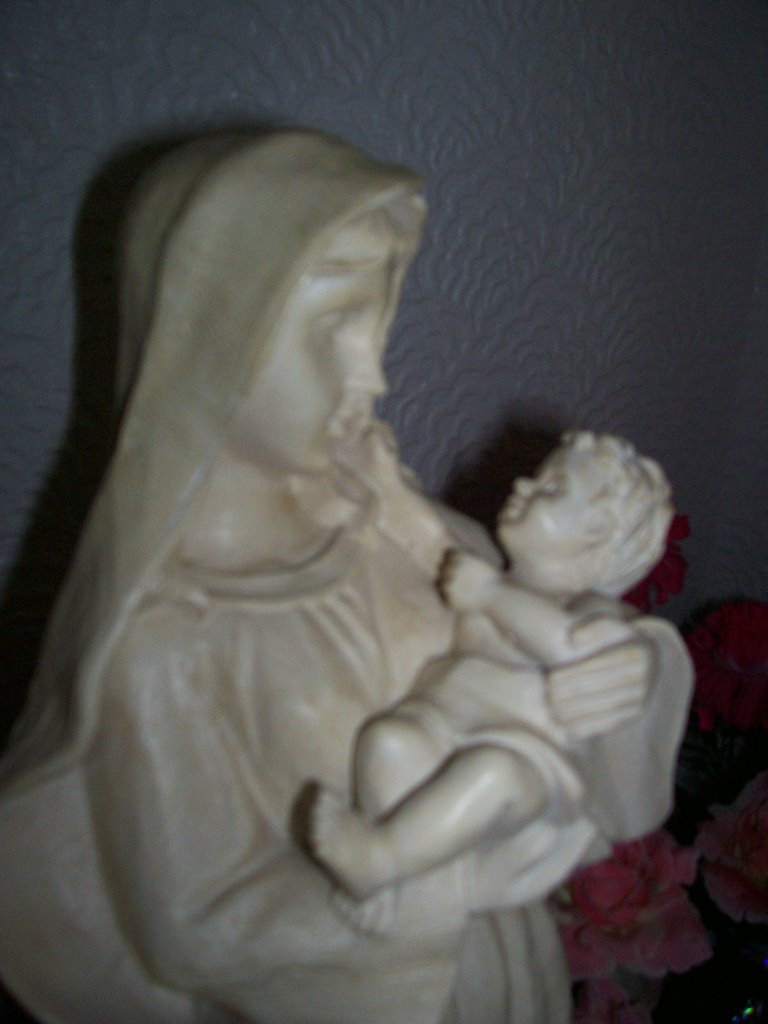
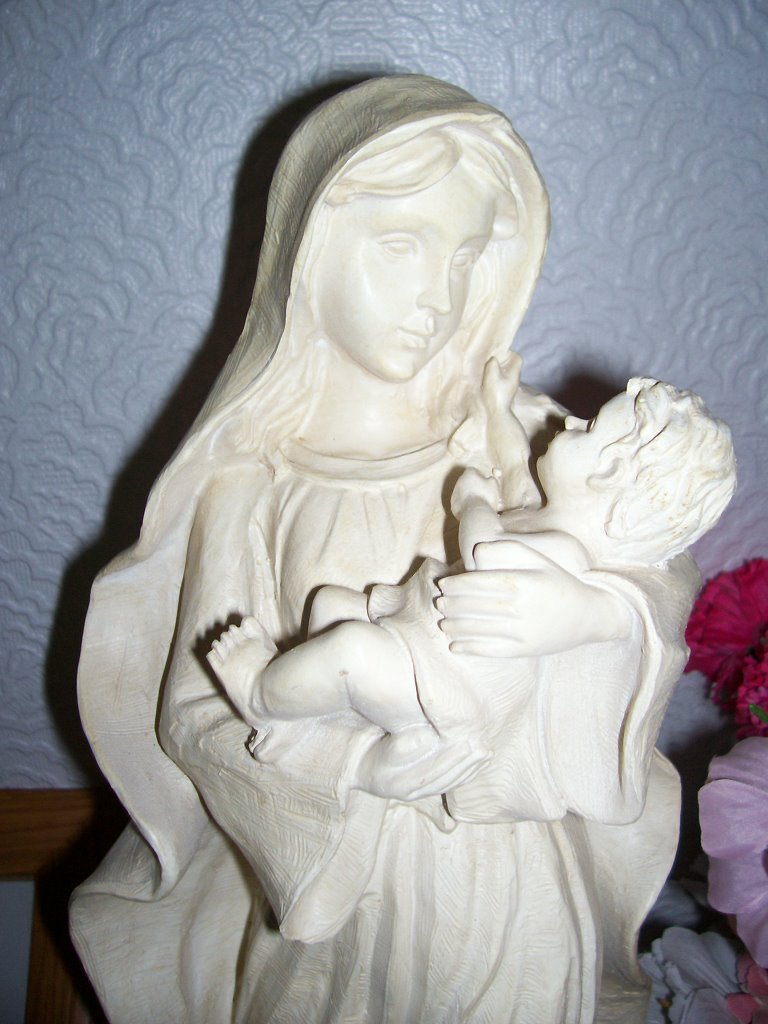
Again, if I can use an example. I have, in my room, two statues of Mary holding the Baby Jesus. One of those statues I bought only because I saw it being sold on the roadside in a most inappropriate situation. The other I bought because I thought there was such tenderness in the statue that I fell in love with it at first sight. I'll attach them to this e-mail (I hope) for you to see. The one statue holds out a smiling Infant and I see, not so much the mother, but the mother who made Jesus smile. In the other, I see the mother who was a real mother. In both cases, she is the Mom, not the Baby, the Life-bearer, not the Life itself.

God bless,
Sr. Janet

Saturday, October 07, 2006

God help Zimbabwe!

Once upon a time, there was a beautiful country called Zimbabwe. There were wide roads, a blissful treat to encounter on driving across the border with Zambia. Suddenly potholes laced together with thin strands of tarmac gave way to highways on which driving became a pleasure.Suddenly, there was time to drive and to keep a lookout for the occasional elephant or warthog. Baboons were spotted regularly. There were peasant farmers working fields with their donkey-drawn plough. On these roads, at strategically regular intervals, picnic areas gave a welcome opportunity to sit and enjoy an attractive stretch of bush or the occasional massive baobab tree, to wonder at its upside-down appearance.

Once upon a time, coming down from a remote village in Zambia, I went into the town in Bulawayo, wanting to buy a ballpoint pen. I found that I had a choice of eight and, what surprised me was that I panicked and couldn’t make a selection. I had to walk around the department store and calm down before I could buy that pen. It sounds silly, but it’s true. It was just that the contrast between nothing and abundance, within the space of a few hours, had been too sudden and my brain hadn’t adjusted.

Once upon a time, I wandered around Centenary Park (was that its name?) in Bulawayo and thought that I was seeing the most beautiful park it had ever been my fortune to visit. There was the fascinating animal orphanage in Chipingali and the breathtaking magnificence of the Matopas, a vast expanse of rocks, panoramic glory and the ancient rock art of the Bushmen.

Once upon a time, coming over the border from Zambia into Zimbabwe, I could give myself a treat and buy an ice cream. I could wander along the Zambezi and sit on the rocks at the top of Victoria Falls, watching the mighty torrent cascade into the abyss, its roar drowning out any sounds of traffic, but somehow allowing birdsong to rise into the air with the soaking spray.

Once upon a time, I drove around the town of Victoria Falls and felt my heart contract in pain as I saw the contrast between the tourist areas and the part of the town where the ordinary people lived in hovels made from pieces of wood and sheets of black plastic that I associate with binbags. If I remember correctly, it was nicknamed ‘Plastic City’.

Once upon a time, I thought of Zimbabwe and thought of so many beautiful places and smiling faces. There was hope…and that was only four years ago.

… and now? I’ve just watched a video showing a Bulawayo, a Beitbridge, Harare, barely recognisable for what they were. They show the new reality of deprivation and hunger, of destitution and despair. There are many ‘Plastic Cities’…and I feel helpless.

God help Zimbabwe.

God bless,
Sr. Janet

Friday, October 06, 2006

Father, forgive...

They’ve been a wonderful example to the rest of the world. Having followed the news reports of the terrible killings in Pennsylvania a couple of days ago, I reckon that the response of the Amish is the most beautiful illustration of the Gospel in action. The whole world can point to their efforts to forgive the child murderer and to embrace his widow, whose heart must be breaking beyond anything she could ever have imagined possible. Sure, some of the reports I’ve seen on TV have been over-sentimentalised, but they have not taken away from the quiet dignity of the Amish. I’ve never met anybody from the Amish community and don’t know too much about the concrete details of the way in which they live out their faith, but one thing I do know from the events of the last couple of days: they have a lot in common with the One who prayed, “Father, forgive them for they know not what they do.”

God bless,
Sr. Janet

Thursday, October 05, 2006

Births, Marriages and Deaths

When I was a child I used to wonder why it was that my mother would pick up the newspaper and turn immediately to the announcements of births, marriages and deaths. I could never see what it was that she found of interest. In fact, when I heard that the column was also known as ‘hatches, matches and dispatches’, I quite enjoyed using this title for my mother’s favourite newspaper column.

Hatches, matches and dispatches. Births, marriages and deaths. These three events are some of the most important in the life of every one of us. We are all only born once. We only die once. Hopefully, most people only marry once. When a couple marry, both families and all of their relatives and friends wish the bride and groom a long and happy life together.

Some time ago, there was an interesting BBC interview with a couple who had married each other nine times and were just about to marry for the tenth time. They decided that they were going to sample as many different cultural weddings as possible. So they travelled around most of the world. They had a traditional Japanese wedding. They had a traditional Australian aboriginal celebration. They travelled to Ethiopia and had a marriage celebration there in one of the villages. Eventually they planned to head back to America and have a church wedding there.

It all sounded a bit crazy, but not half as mad as the man who married his motorbike! It’s true. He was so crazy about his motorbike that he actually decided to marry it and found someone to conduct the wedding ceremony. I saw part of it on the news. The man and his motorbike then went off on their honeymoon!

There have also been a number of couples who have decided to have their weddings in strange places. This often reaches the news. For instance there have been several underwater divers who have chosen to be married on the seabed. There have been those who have decided to celebrate their wedding on the top of a mountain or somewhere else unusual.

When I hear about these unusual weddings, I often wonder about the bride and groom. Do they really understand what is meant by marriage? Do they have any plans for a lifetime commitment? Do they understand the sacrifices that are all part of a happy marriage? There is a time when every newly-wed discovers that life is not going to be as romantic as had been imagined. How many husbands and wives have woken up to hear the snores of their spouse and have realised that snores are going to be part and parcel of the rest of their lives?

I remember reading an interview in which a young couple was asked, the day before their wedding, if they thought their marriage would last. They did not expect it to last for very long……so why marry?

An English couple recently celebrated their 83rd wedding anniversary. He was 103 and she was 98. That was a marriage! A marriage really is made in heaven….and so is each one of us. Marriage is for life, gives life and lasts until death. That’s why my mother finds it interesting to read the births, marriages and death announcements in the newspaper.

Lord, today we pray for all married people. We pray for those who are planning to marry. We pray that they might have the right understanding of, and commitment to, a life together. We pray, Lord, that you will bless them at every moment of their lives together.


God bless,
Sr. Janet

Wednesday, October 04, 2006

St. Francis and Creation


One of the things I love about St. Francis of Assisi is his love for nature. The whole of creation spoke to Francis about God. There was nothing, however small, that didn’t remind him of God. It was not surprising, then, that Creation responded to him.

There was one occasion when Francis visited a town called Gubbio. He learned that the people were being terrorised by a fierce wolf. In typical Francis fashion, he went out of the town to find the wolf and to have a meeting with it. Now normally people don’t have meetings with wolves, but then most of us are not like Francis.

The result of the meeting was that the wolf agreed not to frighten the people of Gubbio if, in exchange, they would give it food. The townsfolk agreed. In fact the wolf and the people kept their bargain so well that when the wolf died, it was given a solemn burial.

But Francis was not only interested in wolves. He also earned himself a reputation for speaking to birds. On one occasion he sent out a large flock of birds with instructions to spread God’s word. The birds flew into the air in the form of a large Cross and then travelled north, south, east and west to obey the instructions of the Little Poor Man of Assisi.

On another occasion, when Francis was preaching, the birds were singing so loudly that he was distracted. He was worried that his listeners would not be able to pay attention to his words. He turned to the birds and told them to be quiet and pay attention. Immediately the birds fell silent until he had finished speaking.

Francis also had a special love for flowers. In fact flowers have often been described as ‘the Franciscan luxury’. When Francis died, his friends and early companions remembered that he had told his brother gardener not to plant vegetables everywhere, but to leave a part of the garden for hardy plants that in time would produce our sisters, the flowers.

How often do we take for granted the animals, birds, insects and plants that are around us? Do we follow the example of St. Francis of Assisi such that the sun and moon are truly our Brother Sun and Sister Moon? If we were to see Creation as our brother, sister and mother, we would treat them with respect. We would be able to look at them and see God. We wouldn’t waste our Sister Water, who is so precious and pure, humble and useful.

Francis praised God for Brother Fire. We use fire every day. It is part of our lives. We are the only part of creation that has learned to use fire as a tool. Do we ever think of thanking God, not only for its usefulness, but also for the beauty of the dancing flames?


Lord, today I thank you for my Brother Sun and Sister Moon, for brother Fire and Sister Water. I thank you for all your beautiful Creation, which tells me of your greater loveliness. I thank you for every creature you have placed on this earth, because you have made everything out of love. Lord, Francis called Sister Earth also our Mother because she gives birth to all living things. I too am part of your Creation, Lord, and this tiny part of all that you have created itself desires to praise you.

God bless,
Sr. Janet

Monday, October 02, 2006

One day at a time

Every morning I listen to the news on the radio. At night, before I go to sleep, I listen to the news. Then, next morning, once again, I listen to the news.

One thing I notice is that there is really little difference between the news bulletin last thing at night and the one that follows it early in the morning. Really, it’s not surprising. Only a few hours have passed between the two bulletins. However, sometimes I half-expect the world to have changed during those few hours when I was asleep. Of course, sometimes there is a major change. There might be a serious earthquake or a plane crash during the night that is so important that it becomes the first item on the news.

For the most part, however, the political negotiations, which are taking place in one part of the world or another, are more or less at the same stage today as they were yesterday. The financial crisis in which one country or another finds itself will be the same tomorrow as it is today.

It would be wonderful if, overnight, whilst the rest of the world was sleeping, two countries, which had been at war, could announce peace. Imagine the effect if, overnight, a country could suddenly find all its economic problems solved. What would it be like if, at night, someone who went to bed hungry, cold and unemployed, could wake up and find himself or herself well-fed, warm and employed? We’d look on the event as something miraculous.

However, life is not like that. I know from my own experience that the problems I take with me to bed are usually still with me when I wake up in the morning. Often they are not solved by the end of the day. There have been so many times when I would have loved to snap my fingers and suddenly find all my difficulties at an end…..but life is not like that.

There is a children’s film about a special teacher by the name of ‘Mary Poppins’. One day Mary wants to help her two pupils to pack their cases to go away on holiday. She clicks her fingers and suddenly, all the children’s clothes and toys find their own way into the suitcases. Within the space of seconds, the suitcases are packed and Mary Poppins and the children are ready to go away on holiday.

That sort of thing does not happen in my life. If I plan to do a job, the job takes time to be planned and to be put into effect. Results do not come instantaneously. Yet it is not always easy to take life one day at a time. I can be impatient for results. I can be impatient for success. I can be impatient for my difficulties to come to an end.

An Indian writer by the name of Tagore wrote that when God created flowers, he made them to open slowly and gently. If a flower opens too quickly, it is destroyed. If we do not take our life one day at a time, we might miss out on the most important lesson that God might want to teach us that day.


Lord, help me to take one day at a time. You know I am only human, but sometimes my human limitations are also frustrating. I’d like to work a few miracles, but then that would make me equal to you. I prefer you to be God and for me to be me. Help me to be patient, Lord. Help me to take one day at a time.

God bless,
Sr. Janet

Bishop Nichols' statement

STATEMENT FROM ARCHBISHOP VINCENT NICHOLS IN RESPONSE TO BBC PANORAMA PROGRAMME, 'SEX CRIMES AND THE VATICAN', ON BEHALF OF THE CATHOLIC CHURCH IN ENGLAND AND WALES

The Most Reverend Vincent Nichols, Archbishop of Birmingham, and Chairman of the Catholic Office for the Protection of Children and Vulnerable Adults (COPCA), has issued the following statement on behalf of the Catholic Church in England and Wales, in response to the BBC Panorama Programme, 'Sex Crimes and the Vatican', broadcast on BBC 1 at 10.15pm on Sunday 1 October 2006:

"The BBC Panorama programme, 'Sex Crimes and the Vatican', makes clear the suffering of those abused in their childhood. But as a public service broadcaster, the BBC should be ashamed of the standard of the journalism used to create this unwarranted attack on Pope Benedict XVI.

"Viewers will recognise only too well the sensational tactics and misleading editing of the programme, which uses old footage and undated interviews. They will know that aspects of the programme amount to a deeply prejudiced attack on a revered world religious leader. It will further undermine public confidence in 'Panorama'.

"There are two strands to the Panorama programme 'Sex Crimes and the Vatican'. The first is a graphic and explicit account of the evil of child abuse and the personal damage it causes to its victims. This is horrific and deeply distressing.

"Those abused as children have been grievously offended. This is especially so when the abuser is a priest. The film is a reminder to everyone of the need to work ceaselessly in the protection of children and in response to the needs of victims. The Catholic Church in England and Wales is doing so, with transparency and care, and, in every case, cooperating fully and immediately with public authorities.

"The second strand of the programme is an attack on the Vatican and specifically on Pope Benedict XVI. This aspect of the programme is false and entirely misleading. It is false because it misrepresents two Vatican documents and uses them quite misleadingly in order to connect the
horrors of child abuse to the person of the Pope.

"The first document, issued in 1962, is not directly concerned with child abuse at all, but with the misuse of the confessional. This has always been a most serious crime in Church law. The programme confuses the misuse of the confessional and the immoral attempts by a priest to silence his victim.

"The second document, issued in 2001, clarified the law of the Church, ensuring that the Vatican is informed of every case of child abuse and that each case is dealt with properly. This document does not hinder the investigation by civil authorities of allegations of child abuse, nor is it a method of cover-up, as the programme persistently claims. In fact it is a measure of the seriousness with which the Vatican views these offences.

"Since 2001, Cardinal Joseph Ratzinger, then Head of the Congregation for the Doctrine of the Faith, took many steps to apply the law of the Church to allegations and offences of child abuse with absolute thoroughness and scruple."

Archbishop Nichols added: "This statement is endorsed by the Bishops of England and Wales. Cardinal Cormac Murphy-O'Connor, as President of the Bishops' Conference, is writing to the Director General of the BBC, Mark Thompson, to protest about this programme. Cardinal Murphy-O'Connor's letter will be made public later this week."
…………………………
Also, listen to a Vatican Radio report on this dreadful BBC programme
http://www.oecumene.radiovaticana.org/en1/Articolo.asp?c=97647

God bless,
Sr. Janet

Saturday, September 30, 2006

Planting a tree

Have you ever watched a new road being laid? There is a great deal of confusion. There are also been many traffic jams and delays.


However, one thing I have noticed is that, on the whole, most people are amazingly good-natured about all the disruptions caused by the road works. In fact, people have become amazingly polite. Suddenly, drivers will stop and signal for another driver to move into the correct lane. I suppose it's because they can see that there is a point to the disturbances. They can see that if, for the time being, people can be patient, the new road will be a great improvement to driving conditions. I'm always sorry to see the number of trees that are cut down in building a new road. I love trees and miss them. I'm glad to see efforts made to plant new ones, but it will be many years before they are big enough to provide the beautiful shade of their predecessors.
Planting a tree is a real sign of hope in the future. A tree takes so long to grow that the person who plants it does not always live to see it attain maturity.

Planting a tree is a sign that the planter believes there will be a harvest. A farmer would not plant his crops if he believed they would not grow. Similarly, trees are only planted in the understanding that there will be people alive to appreciate their beauty when the trees reach maturity.

We all need signs of hope in our lives. What would it be like if all there was to life were to be included in the dreary headlines we see in the daily newspapers? I think it would be depressing in the extreme. Talk about "wars and rumours of wars": there's hardly a day goes by without us hearing of robberies, violence, corrupt politicians and business people, war, AIDS and so on.

At one time someone published a newspaper that only contained good news. It went out of business within a couple of days. We've become used to hearing of all the "doom and gloom". We're like the drivers who deal with the daily traffic jams and forget that there are some days when the road is clear. We see the diversions and forget that there will be, one day, a new road. We see the trees that are cut down and don't notice the ones that are being planted or the trees that were not touched by the axe.

We need hope. We cannot survive in a world that holds nothing but despair. I think that's one of the reasons why God made trees. He's telling us to look at the present, but also to look ahead to the future, a future that we might not see, but which is full of hope. God is saying to us, "Plant now. Sow the seeds of hope in your own little world. Sow those seeds and one day they will grow strong and beautiful. Plant a tree of hope and nothing in this world will ever destroy you. Plant a tree of hope. Make your life a garden in which others will come to rest and find hope." God gave us trees as a sign of hope, his hope, his love for each one of us.

Lord, let me plant a tree of hope in my heart today. Help me to make my life a garden. Let me fill it with promises of love and peace. Let me plant the flowers of goodness, gentleness and kindness. Let me sow everywhere the seeds of joy. Help me, Lord, to plant a tree of hope in the heart of everyone I meet today.

God bless,
Sr. Janet

Friday, September 29, 2006

Burning the cakes

There was a very famous English king by the name of Alfred. He lived more than one thousand years ago and, during his reign, worked hard to establish justice in the country. He made many wise laws and rebuilt the navy. Alfred’s reign was quite peaceful at a time when the lives of most monarchs were spent in waging war.

Alfred was a very good king. However, if one asks most English children what they know about King Alfred, they will usually say that he burned the cakes. In spite of all the wise decisions Alfred made during his reign, the one thing for which everybody remembers him is that he burned the cakes.

What happened was that, at one time, King Alfred was escaping from some enemies who wanted to kill him. He decided to hide in a nearby forest and there, in a clearing, he found a small house. A widow lived there on her own, so the king thought that she would be willing to let him stay there for a short time, until it was safe for him to leave the forest and take up his rightful place in his kingdom.

However, that day, the widow was very busy in the kitchen. She didn’t really have time to wait on the king and wasn’t very happy when he asked if he might stay with her for a while. The old lady grumbled a bit and then told King Alfred that if he wanted to stay in her house, he had better make himself useful. She was baking some cakes in her oven, but there were plenty of other jobs to be done. Alfred must take care of the cakes as they baked, whilst the widow continued with the rest of her work.

King Alfred had not expected such a welcome. He was very worried about how he was going to escape from his enemies, stay alive and rule England. He agreed to watch the cakes in the oven, but his mind was occupied with other things.

A short time later, the widow came into the kitchen and discovered the king sitting in front of the oven. Clouds of smoke filled the room. Instead of taking care of the widow’s baking, he had let the cakes burn………..and that is why, in spite of all the good and brave deeds King Alfred performed in his lifetime, the one thing for which he is really remembered is that he burned the cakes.

All of us would like to be remembered for accomplishing wonderful things in our lives. Which of us, when we were children, did not dream that one day we would be rich and famous? Is there anybody who did not imagine themselves performing some incredibly brave act of rescue that nobody else would dare, and thereby saving many lives? If we are honest, we all had such dreams, and, again, if we are honest, most of us are still waiting to be rich, famous and daring. Most of us will never achieve greatness. Perhaps, when we die, we might even be remembered for a silly mistake, just as Alfred is remembered for burning some cakes.

The good news is that it doesn’t matter if we are never important in the eyes of the world. Each of us is important to God. Each of us is important in the eyes of those who love us. That is of much more significance than the greatest of wealth and fame. Love changes everything and teaches us what is really valuable in life.


Lord, you didn’t call me to be great. You made me very small and insignificant in the eyes of the world, but that doesn’t matter because I’m important to you and to those who love me. It doesn’t matter if people will only remember my mistakes. Grant that they will also remember my love.

God bless,

Sr. Janet


Wednesday, September 27, 2006

The human face of God

She weighed 1.3kg when she died. When she was born, she weighed 0.8kg and was only slightly longer than the palm of my hand. The nursing staff had already given up the baby as dead and, obeying local traditions rather than their training, didn’t bother to ensure that she was fed. Her mother, desperately ill with TB and AIDS (thanks to the husband) crawled to her daughter and struggled to give her what little milk she had. That baby refused to die, regardless of the staff’s indifference. She clung to life for one whole month, determined to survive whilst her mother and I continued to fight for her. It didn’t cost much to keep her alive: only daily love and one or two teaspoonsful of glucose. That was all. But gradually the struggle was too much for her tiny body. Her mother and I were the only ones who cried at her death.

Then there was the young woman who gave birth in the village and who bled. Her elderly parents hired a wheelbarrow because its owner refused to lend it to them. For five hours through the night, not stopping to rest, they pushed their daughter along swampy tracks and through the bush to our mission hospital. My attempts to remove the placenta, the cause of the bleeding were unsuccessful. The young woman was still bleeding. That meant an emergency two-hour drive to the provincial hospital, along a nightmare dirt road, full of corrugations and potholes. When we reached the hospital the doctor was having his siesta and refused to come. When he emerged from his bed, almost two hours after our arrival, because of the roughness of the roads we’d travelled, the placenta had already delivered itself. The young woman lived because of her parents’ love.

Don’t forget the parents whose 10 year-old had very severe malaria. They walked for eight hours, carrying the child, not even stopping for a drink of water although it was the hot season. By the time they reached us, the parents were too exhausted to speak. The father sat on a chair and slept. The mother also sat beside the bed. She struggled to stay awake, holding her son’s hand, but even she put her head down on the mattress and slept. The little boy lived, not because of the medication he received, but because of his parents’ love.

We look at the Crucifix, but how often do we see the human face of God in the people around us? Mary is the mother with AIDS who forgets her own sickness in order to fight for her baby’s life. Mary is the couple who ignore their own advanced old age and push their daughter, in a wheelbarrow, through the bush. Mary is the mother who was oblivious of her own needs in her concern for her son’s survival.

The world has a human face, and in our midst is the human face of God.

God bless,
Sr. Janet

Tuesday, September 26, 2006

Saints are the people who kept on trying...

Have you ever been so busy that you’ve not had time even for a drink of water, so that, by the end of the day, you’ve been quite dehydrated, but haven’t realised, and by the time you wake up in the early hours of the morning, you’ve had a splitting headache, so bad that it feels as though your skull is going to explode? If you’re anything like me, you’ll put up with the headache for a couple of hours, trying to work out its cause. Occasionally you might even wonder if the pain could be symptomatic of something really serious, perhaps even a brain tumour? In desperation you have that long drink of water that you don’t really think you need…. and the headache goes.

Very early the other morning I had such a headache. As often happens in these situations, my thoughts turned to St. Maximilian Kolbe, who is someone I admire greatly, but for reasons that might not occur to many people. You see, it seems to me that he perhaps took on more than he realised when he offered to take the place of a fellow prisoner. It sounds bad enough to agree to be starved to death on someone else’s behalf. However, if I’ve read things properly, he had nothing to drink and so must have been incredibly dehydrated by the time the guards entered the bunker in order to finish him off. I can’t begin to imagine the headache he must have had. To me, the bigger act of heroism was not offering to die, but putting up with the headache that must have worsened by the hour. It feels bad enough overnight, but after several days, he must have gone through agony every time he moved. I honestly don’t know how he did it.

The other thought that occurs to me concerns his actual dying. The guards entered the bunker and gave Kolbe and anybody else who happened to still be alive, an injection of carbolic acid. I don’t know how quickly that kills, but it sounds unbelievably painful.

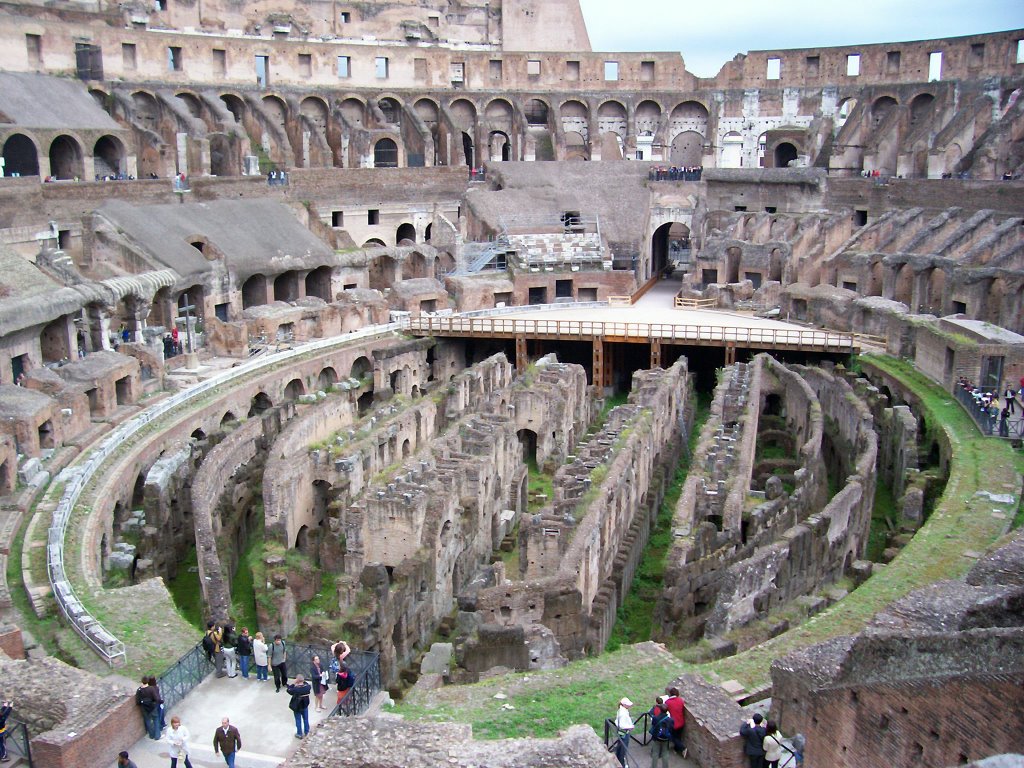
Whenever I stroll past the Coliseum, I wonder what it would have been like for the early Christians as they confronted a lion or two. I’m not sure that I’d have been like Ignatius of Antioch, encouraging the animals to “grind him like wheat”!

Neither am I convinced I’d be happy to be boiled in oil. I made that decision when the hot water in the shower was rather too much for me to bear. Yet St. John was apparently thrown into boiling oil not far from here, at Porta Latina. He was unscathed according to the legend, but he still willingly faced a very hot bath!

When I was in my teens, I saw life in shades of black and white. There were very few grey areas. I was horrified when a friend of mine said that he didn’t think he’d have the courage to be a martyr. I disagreed with him entirely. In fact I rather fancied the idea! Oh the ignorance of youth! These days I admit that I don’t know if I’d have the courage, but hope that I would should the situation arise.

Someone defined a saint as ‘the person who kept on trying when everybody else gave up’. I can cope with that. It puts sanctity within my grasp. I somehow suspect you might think likewise.

God bless,
Sr. Janet

Monday, September 25, 2006

Brad

“What is a weed? Only a flower whose potential has not yet been recognised.” I found that quotation on the front of a card. A weed is a flower whose potential has not been recognised.

A baby is born. Its parents discover that instead of the healthy child they had been expecting, their lovely baby has a disability that can never be cured. How do they react?

I remember the morning a young woman came to me, weeping, with her newborn in her arms. It had something wrong with its knee because it wasn’t quite straight. She thought her baby would be crippled for life. On this occasion the baby’s apparent disability could be easily corrected. I bandaged its knee tightly and instructed the mother not to remove the bandage until the following day. Next morning, the baby’s knee was straight. This young mother’s baby was more than ever a beautiful flower in her eyes.

There was another time when I found a mother crying over her new baby. He was profoundly disabled with something that could not be cured. She wished he had never been born. She could see nothing beautiful in her infant and I knew that when she returned to her village, this baby would not survive. It was tragic. She saw, not a flower, but a weed.

Yet I remember a boy whose disability was far greater than that baby’s. When I knew Brad he was 10 years old but he could only function as if he were a few months old. His mother had to do everything for him. It was pathetic to look at him, to see him lying on the floor, day after day, doing nothing for himself. When he was born the doctor suggested that Brad be left behind in hospital because he would probably not live for any longer than a few weeks. He actually lived for 14 years because of the care he received from his family. The baby that should have died was the longest-living child on record with his condition. The only things Brad ever learned to do were to smile and to laugh.

Many people, looking at Brad would not have seen a flower. They would have seen a weed that needed to be uprooted. His family saw a flower. Even though Brad probably didn’t understand his younger brother and sisters, they never did anything without coming to tell him. When they returned from school, the other children came to tell Brad about their day. He would laugh and then the children would run off to play. Although he couldn’t play, Michele, Stephen and Katie involved Brad in most of their games. They would often play indoors just to give him company. Brad would watch them and laugh.

Everybody in the town knew Brad. They would visit his parents and sit watching the helpless little boy and enjoying his laugh. He nearly died on so many occasions. There was one evening when Brad was terribly ill. His mother told him that although she loved him so much, if he wanted to die and go to Jesus, she would let him go. She wouldn’t hold on to him, however much she loved him and would miss him. On that occasion, Brad did not laugh. A single tear ran down his cheek. Brad had somehow understood his mother.

When Brad died, a couple of years later, the whole town came to the funeral. His broken little body had given laughter. He had somehow managed to make people feel loved. The little boy who had so little potential had enriched everyone who came to know him.


Lord, we pray for the children whose disability leads to their rejection. We pray that they will find love. We also pray for those who are like Brad, whose lives are a beautiful flower, a sign of your great love working through the weakest and most helpless. Thank you, Lord, for the flowers with which you fill our lives. There are no weeds, Lord, you created flowers. We are the ones who were so blind that we called your flowers weeds.

God bless,
Sr. Janet

Saturday, September 23, 2006

Happy New Year!

It sounds a bit odd to be sending New Year greetings in September, but I’m just back from a beautiful Mass in St. Paul’s basilica, a celebration especially for our new first-year students for the priesthood. I suspect that they were all feeling nervous as today is the first day of a whole new way of life for them. They are all ‘late vocations’ and from English-speaking backgrounds, although they are from several different countries and, as older men, have followed very different paths to the start of their seminary days.

The basilica of St. Paul’s-outside-the-walls is a very special place to start off the studies for the priesthood: Sts. Paul and Timothy are buried within the beautiful building. St. Ignatius and his first companions took their vows before the icon of Our Lady in one of the side chapels. 1,300 years of Benedictine monasticism have hallowed the place where, today, millions of people from every corner of the globe, come to pay their respects and to pray.

I imagine that Paul and Timothy must have also felt nervous as they themselves began preaching the Gospel. What was it like for Paul, who had been a persecutor, to suddenly start trying to convince people that he had decided that, for him, "life (was) Christ"? Did he have to face opposition? Did people remind him that he'd been the cause of the death of one of their relatives or friends? Did they ask what he thought he knew as a johnny-cum-lately? Was Timothy scared as he accompanied a firebrand such as Paul? Were there times when he wished he was anywhere other than in Paul's company, especially when the going became tough? How long did it take for Timothy to decide that he had to throw in his lot with Paul and follow him as enthusiastically as Paul himself launched into his new role as 'Apostle of the Gentiles'?

Across the world, there must be many new students for the priesthood taking a deep breath and plunging into a new journey towards God. May he bless them and guide them.

God bless,
Sr. Janet

Friday, September 22, 2006

Let there be love!

There are advantages and disadvantages to not being an expert!

The inspiration to start a daily e-mail of the reflections from ‘Pause for Prayer’ turned out to be easier said than done. I designed (to my mind) a useful format, staying up very late one night and beginning at 05.30 the following morning in the attempt. Feeling very satisfied with the result, I signed up for Google Groups, only to find that my efforts had not been very useful because their format doesn’t accept mine. No problem. I thought their simpler ideas would do just as well…after all, it’s a free service… only to find that there would be a delay whilst they checked out that I’m not a spammer. Fine by me. As Vatican Radio receives a daily superabundance of unrequested spam and weird messages, I think it’s great that there is a filtering system, even if it caused me personally a bit of inconvenience.

Recently, however, I was really angry when I opened up an e-mail that arrived in my mailbox. After spending 9 months in Nigeria and 12 years in Zambia, I saw a number of children who, through a complication of malnutrition, had half of their face eaten away by an awful condition called cancrum oris. It caused so much suffering to the children and to their families.

You can, therefore, imagine my reaction when I saw that someone had decided to cash in on the awful photos of the children with this condition in an attempt to make money. Whoever it was had set up a bogus online charity, had added some of the worst pictures and had sent it off around the world. It just so happened that the perpetrator had missed out on one or two essential details, merely alerting the slightly more savvy recipients to another e-hoax. However I am equally convinced that some generous souls were moved to parting with their cash.

It is so sad that there are people who are prepared to benefit by the misfortune of others, reducing them to instruments of personal enrichment in the wrong way. There are many occasions when the patience, the insight and the determination of those who are suffering is a deeply enriching experience for observers, whose lives can become ever more meaningful. Yet there are those who see the same suffering only as a means to make money. Doesn’t that turn human beings into things rather than individuals loved by a God who himself knows the depths of pain?

Someone said that there are those who use things and love people and there are others who use people and love things. May God touch the hearts of those who can’t see the true value of others. Let there be love!

God bless,
Sr. Janet

Thursday, September 21, 2006

On the road

Public transport is often a useful instrument for observing human nature and behaviour. This morning, for instance, in the early morning light, the sequined shoes of one woman not far from where I was sitting shone with a beautiful array of colours. The cotton top worn by another was equally glistening. I couldn’t wear either the shoes or the top, but the play of light was a fascinating distraction as the bus bumped along the road.

At one stage along the road, a man wearing a trilby hat and a grey business suit climbed on board. As he stood, it was obvious that he was one of the many poor people, often immigrants with no work permits, who try to eke out a living in any way that they can. Why? Well, because his suit looked as though it had been in a washing machine and had not been ironed afterwards. He carried in his hand a bottle of water and a window brush. In spite of the man’s attempts to appear businesslike, he was actually planning to spend his day cleaning car windows and was somewhat embarrassed about the job he was about to undertake.

The contrast was marked: there was, on the one hand, sufficient confidence in life and living to be able to face the day with a bit of a show and an ability to shine. On the other, there are those who find drabness and the burden of dragging through each day. It’s almost like an apology for being alive at all.

Yesterday evening, I sat on the train alongside two small gypsy children, one aged about 3 and the other 5 years old. The bigger girl tried to pull the younger onto her knee, only to have the little one slide off. With much giggling, they repeated the process at least ten times before my exit gave them a second seat. It was so lovely to see the children acting as children, not being used for begging, as is so often the case. There was innocence and enjoyment of each other’s company. There were no problems facing them: there was freedom and a life worth investigating.

Life has many ups and downs. There are moments of sheer joy, but there are also those of deep sadness, in our every day living. The wonderful thing is that, at every moment, we have someone with us, who is intensely interested in all that we say, think and do. Thank God!

God bless,
Sr. Janet

Wednesday, September 20, 2006

Welcome to my world

When I was working as a midwife, I could guarantee that the best way of starting off a day well would be when I could help a new baby be born safely into the world. Sometimes I would have been up for several hours before the birth actually took place. Sometimes it might have been a very difficult delivery. However, I truly believe that the most beautiful sound in the world is when a baby cries for the first time.

There were a number of occasions when a new baby did not breathe as soon as it was born. Sometimes it was hard work trying to encourage the infant to take its first breath. There was always a special moment when tiny lungs began to fill with air for the first time and a tiny chest began to move. Until then, everybody would be waiting anxiously. Often the mother would be lying watching and waiting to see if her baby would live. Then there was that special moment, that very special moment, when suddenly the silence of waiting was over and there was a cry, weak at first and then becoming stronger and stronger. The louder the baby cried, the happier the smiles of the mother and the midwives.

For me, as I left the labour ward and went in search of a well-earned cup of tea, it always seemed that the birds would be singing loudly and celebrating the safe arrival of a new baby. It was always as if the sun was shining more brightly and the world was celebrating the new life. It was as if the whole world were shouting out its welcome. For me, I always felt like dancing.

I believe that the safe birth of a baby is always a cause for rejoicing. A baby is a gift from God to its parents. A baby is an invitation from God to a husband and wife, asking them to share in his sacred work of Creation. God is love. He created the world and everything in and on the world as a sign of his love. Every baby, therefore, should be created out of the love of a husband and wife for each other. Every baby should be born into a family where it will find love, acceptance and understanding.

Some years ago I was talking to a young woman who had many serious problems in her life. She was finding it very difficult to cope and was severely depressed. As I listened to her, I discovered that her mother had tried to abort the girl, but had not succeeded. Knowing this had made such a serious impact in the girl’s life that she had never been able to find peace or happiness. Always in the back of her mind was the knowledge that her mother had tried to kill her before she was born.

God did not intend that anyone should be in this position. God created our world and welcomed us into his Creation. He made the world with us in mind. That is why Jesus instructed us to knock at the door of his heart because it would always be open to receive us. He told us to look for him and we would always find him. Every moment of every day, God is welcoming us into his world. He is inviting us to listen to him, to trust him and to love him.


Lord, you are my Creator and my God. You are so great and I am so small, and yet you love me. You created your world for my benefit. Every tree, flower, blade of grass, animal and bird was created for me to love and enjoy. Help me, Lord, to respect and love your world. Help me to treat it with the same tenderness that you show to me. Help me to preserve your world’s loveliness for those who will live after me. Thank you, Lord, for welcoming me to your world.

God bless,

Sr. Janet

Tuesday, September 19, 2006

Blessed are the Meek: they shall Inherit the Earth

A children’s hymn begins with the words, “Gentle Jesus, meek and mild…”, but I have to admit that the children don’t know what it is that they are singing. Neither do some of the artists who try to portray a meek Jesus and instead end up with something sentimental and effeminate.

There is nothing weak about meekness. The meek Jesus was able to stand up to the opposition of the scribes and the Pharisees. He stood before Herod and Pilate. He stretched out his hands and allowed himself to be nailed to the Cross. Meekness is associated with immense strength and courage, not of defencelessness and timidity.

One paraphrase of this Beatitude says, “Blessed are those who let God be God…” Perhaps that expresses something of its essence.

What does it mean to let God be God in my life?

For a start, it means trusting that God knows what is best for me. It means a commitment to follow him in good times, but also in bad, believing that whatever route he leads me will be for my ultimate happiness?

Life can be completely revolutionised by letting God be God. It’s so difficult and wearying when I try to do all the planning and to organise everything according to my own ideas. I find myself trapped inside my own head and within my own environment. I can’t escape from myself or my problems. Life becomes an endless struggle to put things right.

It might take courage, but in the end it’s so much easier to put everything in God’s hands and to trust that he knows best, whatever will happen. There will be times when the way ahead is anything but clear. It is obscure and frightening, as frightening as anything can be. There will be sleepless nights when I will wonder if God really does know what he’s doing because if I were God I wouldn’t do things in such-and-such a way. But that’s the whole point. I am NOT God. I don’t know best. He does. If I am prepared to take a deep breath and renew my resolve to trust in him, somehow things are not so frightening any more. I’m not alone. Gradually I will discover myself coping as I’d never done before, because I have the confidence that God is with me and in me.

Letting God be God in my life means becoming aware of what is right and wrong, both within me and outside in the society in which I live. It compels me to challenge both myself and my society to something more God-like. That can mean confronting injustice and evil in spite of serious personal consequences. Do I accept wrongdoing or do I challenge myself and others to a better life in the same way that Jesus did?

The consequence of Jesus’ meekness was crucifixion. Jesus did not have an easy life. He paid with his life for having confronted the evils of his time. The more closely I identify with the meek Jesus, the more likely I am to find that my way also leads to the Cross. Yet because Jesus allowed the Father to be the Father, the result was the Resurrection. If I am one with Jesus in his passion and death, I will also be one with him in his Resurrection. I shall also have the earth for my heritage.

God bless,
Sr. Janet

Monday, September 18, 2006

Blessed are the Peacemakers

It is dangerous to be a peacemaker, one who enters the arena of turmoil and dissension and brings harmony. Peacemakers are not popular. They go to the front lines of battle and risk life and limb in the cause of peace. Warring factions both want the peacemaker to be on their own side. Neither wants compromise. Neither wants to recognise truth and legitimacy in the other.

Battle happens when there are factions and neither will give way. Minds are closed and stubborn. Battle means winners and losers, a victor and the vanquished. A peacemaker suggests that there is no need for winners and losers, no need for conquests.

There is a saying that in every argument there are three points of view: your story, my story and the truth. A peacemaker listens to both sides of a dispute and encourages all parties to work towards the truth.

Peace is more than an absence of conflict. A lack of conflict might be no more than an indication of apathy, indifference and lack of involvement.

Look at a family in which the members no longer talk to each other. There might be no fighting as they go their separate ways, but neither is there love and so hearts are not at peace. Where employers and employees no longer share their hopes and dreams for their work, there might be physical togetherness, but there is no shared goal and people become disposable. Instead of peace, there are industrial disputes, hardships, and personal misery.

Peace is active. Peace needs to be taken with both hands and a will to work for its realisation. It demands 100% commitment. A peacemaker sows the light of love where there was the darkness of hatred, pardon instead of injury, faith instead of doubt, hope rather than despair and replaces sadness with joy.

Lord, make me an instrument of your peace.

God bless,
Sr. Janet

Sunday, September 17, 2006

Poverello

Was he really so poor, the ‘Little Poor Man of Assisi’ on September 17th 1224? Deeply praying that he might be more truly configured to the Lord who was his ‘God and All’ Francis became the first person in recorded history to be marked with the stigmata. In his heart, ever since his conversion, he had been crucified with Christ, now he was physically one with his Lord. A life of agonising pain and sickness lay ahead of him, but from this moment, Francis was truly ‘the richest of poor men’. No wonder he prayed as follows:

Lord God:you alone are holy,you who work wonders! You are strong, you are great, you are the Most High, you are the almighty King, you, holy Father, King of heaven and earth.
Lord God: you are Three and you are One, you are goodness, all goodness, you are the higest Good, Lord God, living and true.
You are love and charity, you are wisdom, you are humility, you are patience, you are beauty, you are sweetness, you are sefety, you are rest, you are joy, you are our hope and our delight, you are justice, you are moderation you are all our wealth and riches overflowing.
You are beauty, you are gentleness, you are our shelter, our guard and our defender, you are strength, you are refreshment, you are our hope. you are our faith. you are our love, you are our complete consolation, you are our life everlasting, great and wonderful Lord,all powerful God, merciful Saviour!
Amen.

God bless,
Sr. Janet

Saturday, September 16, 2006

Marked with the Cross

Sunday 17th September is the 772nd anniversary of the day when St. Francis of Assisi became the first recorded person in history to receive the Stigmata. In case you are interested, here is a small reflection from the programme I prepared for Vatican Radio: http://62.77.60.84/audio/ra/00059422.RM

The entire English programme can be found at http://www.oecumene.radiovaticana.org/en1/index.asp

God bless,
Sr. Janet

Friday, September 15, 2006

Good deeds?

Even I am not THAT stupid!

Coming out of Vatican Radio yesterday, a man in a dark blue saloon car stopped beside me. He needed to find the church of St. Mary Major's. Not too difficult, although as I tried to describe the route he should take, I wondered why he had a problem when he was holding a map in his hand. I also noticed his credit card stuck into a peculiar place (for a credit card) in his dashboard.

During the course of the conversation, the man informed me that he works for Pierre Cardin and that he has two brothers in Rome who are priests, that he is from Mexico and that he speaks no Italian. He showed me his business card. Every other word was one of gratitude for my kindness in explaining his route to St. Mary Major's. He called down all sorts of blessings upon me for doing the sort of helpful deed that anybody living in Rome is called upon to perform time and again.

The man was apparently so grateful that he gave me a leather jacket (Pierre Cardin) to show his thankfulness. I was very taken aback because there had been no difficulty in my good deed.

There was a catch...he'd had his credit card stolen the day before. Could I please give him 10 Euros for fuel? I've heard man stories like that, so I refused. Well, if I couldn't give him 10 Euros, could I make it £10?

No? The jacket was grabbed back from my hands and another conman sudenly found that his car was working after all as he sped off down the road!

Didn't Jesus say something about having to have the same sort of savvy as 'the children of this world'?

God bless,
Sr. Janet

Wednesday, September 13, 2006

A world for praise

My favourite image of St. Francis of Assisi is the true story of when he was walking in the woods and felt so happy and bursting with joy that he picked up two sticks and pretended they were a violin.

Francis was a saint of music and of joy. His Canticle of the Creatures was composed when he was physically broken, blind and plagued by the mice that ran over him as he lay, desperately ill and moving towards his own meeting with Sister Death. At a time when most people would concentrate on themselves and their own illness, his thoughts were of heavenly things and of gratitude towards the God who was his all. Unable to bear the sunlight he loved, with even moonlight too bright for his diseased eyes, he sang, exhorting Brother Sun to praise God the creator. Francis congratulated Brother Fire for its light and warmth, when that very light and warmth had been used with agonising and useless results in the hope that cauterising his temples would bring a cure to his eyes.

For Francis, the whole of Creation was a sign of God's love for the world. I remember that when I saw Victoria Falls for the first time, all I could do was to wonder how anybody could see the magnificent cascade and still say that there is no God.

Lord, open our eyes and our hearts to see your love and your beauty in this world of ours.

God bless,
Sr. Janet

Monday, September 11, 2006

A new day

The route is spectacular through the Vatican to the room from where a small group of us broadcast the multilingual commentaries for various Papal ceremonies.

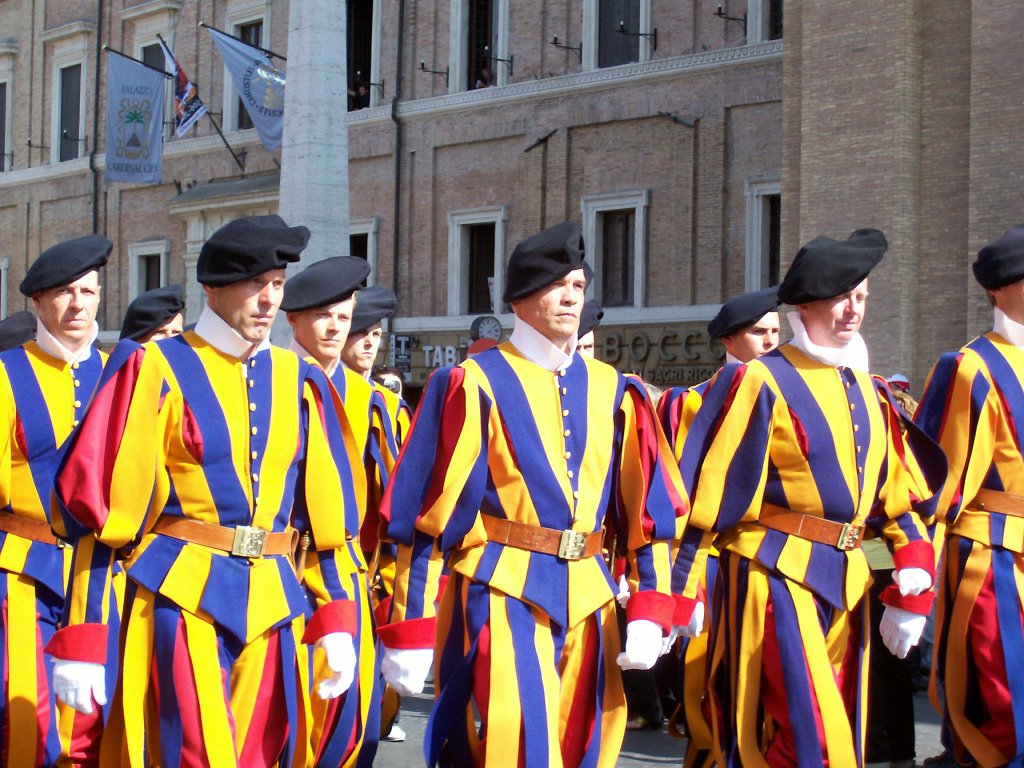
First of all, there is a series of doors, guarded by Swiss Guard in full uniform. Production of the necessary Vatican Radio ID normally results in a cheery smile, a salute and a word or two in whatever language happens to be the one for today. They all speak German, have acquired Italian (except for the couple of Guard who are of Swiss-Italian origin in any case. English is common and, presumably, they all speak French as a matter of course.

There is a lift up to the appropriate floor, but there is also a possibility of going on foot up the beautiful marble steps leading from the Bronze Door. They are tiring and longer than they look. The steps were also deliberately shallow because, at one time, they allowed for horses to be driven up their length. They are, in addition, an interesting optical illusion because, faced with a relatively short corridor, the architects of St. Peter's and the Vatican created this particular flight of stairs to look as though it is considerably longer than is the reality. (Mind you, they are still more than long enough if one is a bit late and is in the desperate hurry that has sometimes been necessary!)

Conscious that one of the side doors off this flight of stairs just happens to be an entrance directly into the Sistine Chapel, there is a big enough surprise when going through the door at the top. It's very heavy but amazingly 'sweet' in the way it swings so easily and silently on massive hinges, to reveal the beautiful frescoes and sculpted marble curtains of the Hall of Kings. Once upon a time, this was the place in which kings waited for their audience with the popes. Now it's just a path that I regularly take, marvelling at the exquisite beauty... but then Raphael was, as were some other great artists, 'just the house painter'!

As the new day dawns, I'm just about to retrace the same path of yesterday, ready for another English commentary for another Papal Mass from Germany. Yesterday's was sheer delight. The music was wonderful, the weather perfect, the Pope looking as though he was enjoying every minute of the celebration. I did too, once the technician had tinkered with a connection to my headphones and I was no longer receiving the German through one ear, an Italian commentator through the other whilst I tried to speak in English!

A new day dawns. Some things can be predicted. Others can't... but isn't that also a sign of God's love? No two days are identical and each day has its own moments of loveliness.

God bless,
Sr. Janet

Sunday, September 10, 2006

White Night

White Night... La Notte Bianca... the night of the September full moon...and Rome comes alive! Last night, hundreds of thousands of the young and the young at heart crowded in a massive moving phalanx into the centre of Rome, all of them with the intention of seriously enjoying themselves.

In the midst of a wonderfully happy, relaxed atmosphere, with the warmth of a late summer evening, young and not-so-young wandered around free-for-the-night concerts, art galleries and museums.

Frankly, the mood was so contented, it was just lovely wandering around and enjoying other people's pleasure. certainly, there was security: I saw two police cars early in the evening as their occupants began the onerous task of diverting buses and taxis from Piazza Venezia. After that? I don't know that I saw one police oficer, and yet I don't think that there was a single person who felt insecure.

I myself visited one of the several large buildings of 'palazzi', normally not open for public scrutiny. Magnificent! I'd have preferred it had thre not been guided tours as the guide concentrated (at length) on paintings and frescoes, ignoring the incredible architecture and inlaid wooden and marble furniture.

Last year I indulged in the building currently rented by the French Embassy for a peppercorn rent. That particular edifice contains a room in which the frescoed ceiling inspired Michelangelo to paint the roof of the Sistine Chapel! If it inspired Michelangelo, it did more than that for me!

We are surrounded by loveliness. There is so much simple pleasure in sharing happiness. Why don't we share some happiness today?

God bless,
Sr. Janet

Friday, September 08, 2006

Happy Birthday, Mary!

Today we celebrate the Feast of Mary's Birthday. Of course we don't know whether or not it is her actual Birthday, but we have the opportunity to rejoice that she was born at all, and that she lived on this earth.

When I was running the Catholic radio station for the Archdiocese of Lusaka in Zambia, we made a point of celebrating Mary's Birthday. There were special programmes. Our younger announcers organised themselves for a 24-hour live broadcast, telling our listeners well in advance that the day was to be special. It was a day of rejoicing, with happy music. Parishes produced programmes with a Marian theme. There were phone-ins with people telling the audience what a difference Mary had made to their lives.

There was no sentimental exuberance about the day: we just wanted to say thank you to our mother for being herself and for supporting our own mothers. We wanted to say thank you because she said 'yes' and brought Jesus into the world. We wanted to say thank you to God for giving us our Mum! We wanted to say, ' Happy Birthday, Mary!'

God bless,
Sr. Janet

Wednesday, September 06, 2006

Foundations

It has been a tiring, but rewarding day. This afternoon I took a visitor to the church of the Twelve Apostles in the centre of the city. It's a church I love , even apart from its history. Somehow it never ceases to be a surprise. Perhaps it's because I've never been there when the lighting has been the same as on a previous occasion. As a result, it's always old and yet always new.

Under the main altar is a 'confessio', steps leading down to what I can best describe as a sort of crypt, but which was actually a Roman villa and which is still virtually intact. It's covered with beautifully preserved early Christian frescoes, including a lovely one of Jesus as the Good Shepherd. The Romans couldn't bring themselves to portray the Cross, an all too true horrific reality in their daily lives. This beautiful crypt, with its graceful pillars and alcoves that would have been graced by statues, encloses the tomb of the Apostles Philip and James the Less. There are also the tombs of a couple of other early Christian martyrs, about whom I know nothing.

As far as I can gather, the villa was a sort of 'safe house' during the persecutions. The tomb of the Apostles was kept inside the house so that people could call in to pay their respects, ostensibly as visitors to the householders, but actually retaining a degree of cover for the real purpose of their coming. Seeing its structure today, it is very easy to imagine people being able to slip in and out without attracting too much attention. The main street, visible today, was only a couple of yards away from the tombs.

It is a special privilege to be able to step back in time and, for a few moments, revisit the very foundations of all that I believe. Admittedly, by being in Rome, I have a very precious means of doing that, but I don't need to actually go to a particular place. My real foundation is inside my heart. My real foundation is my God.

God bless,
Sr. Janet

Tuesday, September 05, 2006

Message from God

There can be unexpected treats. This morning I wanted to prepare a reflection in advance for the Feast of St. Francis on October 4th. I'd already decided on the programme content, but as St. Francis is such an Italian saint, decided that I would ask someone from the Italian Programme to read the Praises of God that he wrote for Brother Leo. The accent would be perfect.

The recording was done, so I sat down at the computer to listen to the result. My colleague had read so beautifully that I found myself sitting in front of my computer and praying. With a musical background of the theme from 'Brother Sun, Sister Moon', I couldn't resist playing and replaying the same piece several times.

It seems to me that God manages to put unanticipated pleasures on our paths from time to time, just as a little treat to lighten up the day. They are just a little way of saying, 'I love you'.

God bless,
Sr. Janet

Monday, September 04, 2006

Buttons

Buttons are the single most abundant item left behind on a battlefield, according to archaeologists. They are more durable than human tissue. They fall off during the heat of battle and fighters are too preoccupied to pick them up and save them for later replacement. Buttons are lost when someone is wounded and a comrade has to pull open any clothing before being able to offer first aid...

I thought of buttons after speaking to an Iranian priest who has just returned to Rome to continue his studies in this academic year that will be opening very shortly. He described the difficulties he has in obtaining a visa, the hours he spends being checked at airports when he offers his passport, the rudeness of officials and the unnecessary hassles of travelling. All this from someone who couldn't be more kind, gentle and totally committed to his priesthood and to his suffering people.

This same priest spoke of the fear he met amongst ordinary Iranians, who are caught up in something over which they have no control. They fear that fighting and war are inevitable because governments are bickering over their own interests rather than the real needs of real people who will have to suffer the consequences.

It seems to me that war is something that is made by the people at the top and fought by the people at the bottom. Those in government are the ones who remain safe. It is the lesser people who are injured, made homeless, have their livelihoods and families destroyed and who die.

How many buttons are being left behind today in the places of unrest across the world? How many buttons will remain before there is peace?

When will governments realise that there is more to peace than an absence of fighting? How many buttons will it take?

God bless,
Sr. Janet

Saturday, September 02, 2006

Who needs fame!

I can’t say that I’ve ever had a relationship with a camel, or a dingo for that matter, but I just happen to have been watching television whilst I had lunch and saw an excellent programme on both animals.

I do remember my first encounter with a dingo when I was in Australia: there was an unearthly howl that sent shivers up and down my spine, which one of my companions told me had come from the throat of a dingo. Well, I was glad it wasn’t a dark night with just the dingo and me out in the outback. I’d have been imagining all the “ghoulies and ghosties and four-legged beasties and things that go bump in the night”!

The next encounter with a dingo was in a wildlife sanctuary, when I accidentally bumped into the wire netting surrounding the dingo enclosure. That was when I saw the force and the speed of the animal’s reaction as it growled and hurled itself in my direction. Thankfully, the netting stayed intact!

It was whilst I was watching the camels and dingoes on television today that I, for some unknown reason, remembered Mr. Yarwood, an elderly man long since dead. He had the most beautiful Border Collie I’ve ever seen, but could he talk! I was in my very early teens when I first met him, and it wasn’t always easy to be polite and listen to all he had to say. Still, I do remember being told about the axolotyl, a creature which sounded like a cross between a lizard and a fish. According to Mr. Yarwood, there was very little that he himself had not accomplished in life, but the axolotyl was the summit of all that he had done: he just happened to have been passing his fish tank when he noticed his axolotyls were in the process of reproducing. It seems he was the first person to see the process and write about it. In honour of this accident, he was made a Fellow of the Royal Society.

Not all of the world’s greatest discoveries are made after long years of research and vast sums of expenditure. Many of those that are most important will remain locked inside our own hearts. There’s the discovery of a new and beautiful sunrise, for instance, or of a previously unnoticed birdsong. Perhaps I’ve just realised that an acquaintance has become a friend. My discovery might be as mundane as a different flavour of ice cream. Yet these discoveries are all part and parcel of my daily life, each one contributing to make me the person I am today, each one helping to make my life worth living. I don’t need a great name to enjoy a life that is great in my own eyes and in those of the people who mean most to me.

Who needs fame!

God bless,
Sr. Janet

Friday, September 01, 2006

Pride and prejudice

I had an interesting experience this afternoon. A woman climbed on the bus at the next stop to mine and either didn't know or else didn't care that I could easily recognise her as one of the many professionalbeggars who alternate between St. Peter's and St. Paul's.

Today she had been begging at St. Peter's. Once she sat down on the bus, out came her large bag, into which she stuffed her hastily rolled-up, black, widow's weeds. Then she could sit comfortably in her lightweight orange top and royal blue skirt.

A few minutes later, out came the bag for a second time. On this occasion she counted some of the money she had obtained this morning. Shortly afterwards, out came a second clinking mound, which she also counted, pouring both into one of the bag's compartments. At a very rough guess, she had made at least 60 Euros...plus two expensive pairs of children's shoes, which were also examined in detail.

The woman sat quietly for a while before opening up her bag yet again. This time she debated between a rather attractive sandwich and a fresh peach, opting for the peach, which she duly sat and ate.

Eventually it was time for her to disembark. The bag and her over-sized black crutch, normally an essential to her every step, were gathered up and hung over the woman's arm. Without a sign of a limp, she swung her way across the road towards St. Paul's, where she would once again become the crippled, grieving widow, duping unsuspecting pilgrims.

It was time for me to leave the bus. I excused myself to the young man sitting beside me with his book. He'd achieved something I couldn't because I suffer from horrible traffic sickness if I dare try to read on a moving bus. As I clambered past him, I noticed his hands and his right arm. His arm was seriously malformed from birth. His hands both bore only two fingers and a thumb, resembling claws rather than hands. He had such dignity. In no way could I imagine himself begging for help, yet he was so obviously limited in his activities.

I know which of the two passengers earned my respect.

God bless,
Sr. Janet

Immigrants

I'm not too sure what to think. I keep hearing both sides of the immigration argument. It seems to me that there are advantages and disadvantages on every side and that what it actually boils down to is that I want my own country to be just as I would like. I wonder if I am being selfish?

I can trace my own origins in England back to the year 1066, when the de Percey family came across from Normandy with William the Conqueror, and back into Normandy until 865. But, when I think about it, what do I actually want? Well, I want to retain my history and my culture…but then nobody is stopping me enjoying my history. It's all there for me, and as for my culture, isn't that something I can celebrate even whilst I live in Rome and enjoy a different one?

People have been pretty mobile throughout history. Rome has been accepting individuals from every corner of the earth for millennia. This has given it a unique flavour, but there's nobody saying that Rome is not Italian, even with the multinational population of today. Tell an Italian that Rome is not truly Italy and there will be a torrent of gesticulations and words, at the end of which, shoulders will be shrugged and nothing else will happen anyway.

I've been an immigrant in Italy, Australia, Nigeria and Zambia, but somehow that's a bit different. Aren't immigrants 'other people'? I've expected to be welcome as I've moved around. I've expected courtesy and the wherewithal to get on with my life in peace and freedom. I think I've contributed something positive in each of the countries in which I've lived, but I also expect that, one day, I'll probably go back home and spend the rest of my life in England, thoroughly enriched by all that I've seen and enjoyed elsewhere. Isn't that exactly what other immigrants do? I don't think I've been expecting specialised treatment and freebies. I've expected to work. I've expected to make adjustments to my new surroundings. I've made efforts to learn other languages even if I've not necessarily been successful…

I don't know what the answers are to the questions of immigration that I keep hearing. I do know that I can stand in St. Peter's Square and don't need a visa. I can be there because I have a right to be there, simply by being human.

It seems to me that everything boils down to a question of the rights that God gave us. Everyone has a right to a home, to food, clothing, education, health care, but with rights, there are also duties. If the world's resources were to be evenly distributed, would people pour out of one country in order to go to another? Wouldn't it be far more convenient to stay at home?

Whilst I was on holiday, I visited the museums in Liverpool and was captivated by the family group in the photo alongside this reflection. They represent a family who left England, hoping for a better life elsewhere. Isn't that something that has always happened? What would life be like if we were all to have and enjoy all that we needed for a secure, happy life for ourselves and our families? Would we be immigrants or would we simply feel that we had come home?

God bless,
Sr. Janet