Thursday, November 15, 2007

Scholastica foils Benedict

I love my sister, but this is beyond a joke!

Of course, it was good to see her and I was as happy to be with her as she was to be with me. We had so many things to discuss because it was quite some time since we were together.

It was inevitable that we should begin to talk about heavenly matters because it is something we have done since we were small children. Neither of us noticed that the time was flying past, so captivated were we at the thought of all that God has done for us.

She is a very holy woman, Scholastica, so that she has had many insights that have touched my soul and have guided my path. Not that I would necessarily tell her exactly how impressed I am with her goodness. A brother has never done that for a sister, has he? In any case, it is sometimes embarrassing to know how highly she regards me and so I do what I can to bring her down to earth. On other occasions, when I think I am progressing quite nicely, she cuts me down to size with the sort of commonsense comment that only a truly loving family member can level at another.

This afternoon, Scholastica came to visit me. I did not mind too much that I was drawn away from my customary period of prayer because our conversation was so caught up in things of God that we broke off from time to time in order to reflect on the words of each other. If that is not prayer, then I don’t know what is.

The trouble came when we realised how late it had become. The sky was becoming dark and so I suggested to Scholastica that it was time for her to leave. She refused, so I insisted. After all, I did not want her to stay overnight in the monastery. What would the monks have said?

Scholastica decided to take things into her own hands. She can be incredibly stubborn, you know.

My sister sat where she was and prayed for a moment. Naturally, I did not want to stop her. I half-thought she might be praying for me before we parted. Hah! If I had known she was actually asking God to keep her here for the night, I would have called a halt, even to prayer. There are some acts of God that are downright inconvenient…such as this one.

Scholastica’s prayer was answered immediately. The sky suddenly became as light as day and there was a massive clap of thunder. Rain began to pour from the heavens in torrents. How could I possibly allow her to leave?

Scholastica looked up from her prayer with a grin that I can only describe as triumphantly wicked! She and God together had foiled me! She could not return to her convent tonight. My sister was not ready for us to terminate our conversation and it looks as though God had the same idea. What do I do when confronted by their joint determination?

I give up!

God bless,
Sr. Janet

Wednesday, November 14, 2007

Margaret Clitherow anticipates her execution

My dearest husband and children, who would have ever thought that our greatest fears would come true and that I would be facing death within three days from now, even though I have made no plea either of innocence or of guilt.

I could say nothing. You know that. If I had declared that I had been hiding priests in the house, then not only would they have been at risk, but so would you, whom I love so much. Could I have even thought for one moment of endangering you? Never! Those who had attended Mass, however secretly, would also have been put in peril of a brutal death. You would have been forced to testify against me and I could not have you faced with the dilemma of either being untruthful or, instead, condemning your wife and mother to death.

Neither could I myself say that I had not harboured priests and have sent them safely on their way, for that would have been a lie. Even if it means that I will die a death which chills me to the bone with fear, I will not lie.

I took the middle path and refused to testify in court, even though the lawyers tried to frighten me with the consequences. They succeeded in one thing: they truly terrified me. The consequences of my silence are as severe as an admission of guilt.

Peine forte et dure. That is the penalty. Tomorrow I will be removed from this prison cell and will be forced to lie on the ground, where they will fasten me so that I cannot move. The judge showed a little leniency because if he had adhered to the strict letter of the law, I should be naked, but he has relented and has allowed me to wear a light cotton shift that I have made in anticipation. He has also allowed that, on alternate days, I will be allowed to drink a little puddle water, but will be denied food. On the second day, I can eat some bread, but cannot drink.

“You must return from whence you came, and there, in the lowest part of the prison, be stripped naked, laid down, your back on the ground, and as much weight laid upon you as you are able to bear, and so to continue for three days without meat or drink, and on the third day to be pressed to death, your hands and feet tied to posts, and a sharp stone under your back.”

My dear family, the words of the judge are engraved in my soul. Is it any wonder that I am afraid? I would have loved it so much if I had been allowed to continue serving in our little butcher’s shop in The Shambles. I enjoyed that work, you know, because it gave me so many opportunities for meeting and helping people. It was easy to pass on messages about the dates and times when a priest would be available for Mass and the Sacraments. I suppose it was also the way in which I was discovered. There was a young Flemish boy who passed on information to the authorities when they intimidated him and promised to kill him. I cannot blame him for showing them where I had hidden the vestments and the chalices.

John, my dear husband, I have been so proud of you. You have been good to all of us. You know as well as I do that although I reverted to Catholicism and you chose not to do so, your brother was one of the priests who found safety in our home. You were so good not to admit that our son is himself studying for the priesthood.

Henry, William and Anne, as you can see, I have taught myself to read and write whilst I have been in prison awaiting my trial. There is so much that I would say to you, my dearest children, but just know this, that however much your father and I love you, God loves you even more. "I know of no offense whereof I should confess myself guilty. Having made no offense, I need no trial." This was my message at the trial and it remains my defence. Be strong. Give your lives to our beloved Lord.

I now take my leave of you all. I love you with all my heart. Pray for me that I might be strong to endure the death that I must soon die.


God bless,
Sr. Janet

Tuesday, November 13, 2007

Thomas More receives a visit from his daughter

Meg! Meg! My darling, beloved daughter, has any father ever loved and admired his child as I love and admire you? My pride in you is boundless. I know that your love for me is every bit as great as mine for you, but can you not see that your words are foolish? I know that they are spoken from the depths of your heart and that all you are doing is to try to save me from the executioner’s axe, but even though I do not want to die, I cannot go against my conscience. It is in my conscience that I am at home with my Lord and, whatever the cost, I cannot deny my God.

I cannot say aloud that the determination of the King to marry Ann Boleyn is wrong because if, in court, you are asked if you ever head me criticise Henry, you can then, with your own clear conscience, say that I have never spoken any criticism of the King in your presence. I must carry my own condemnation of his intentions in the silence of my heart and let the law take its course.

You say that the law is an unjust law, but I cannot allow you to say even that. Without the law, where would we be? It is a protection and a freedom and, even if it cost me my life, I stay within the law. I have said none wrong. I have done none wrong, and if this is not enough to save me from the gallows, then so be it.

But, my darling Meg, you look so worried as you sit there speaking about a possible way out of this cold cell. I could sign the document allowing the King to marry his mistress, but deny my consent in my heart. That is dishonest. What would people say? That Thomas More had finally given way on the very subject that had led to his fall from office and that had led to this cell in the Tower of London? What example would that be? Even if others have signed, I cannot. Neither could Bishop John Fisher. It was just this morning that, as I looked from this tiny window, I saw him being led out on his journey towards Tyburn. I watched him leave through Traitor’s gate, and as the barge disappeared from view, I reflected that never was there a man who was less of a traitor than he. My heart is breaking that, in this country of England, such a saintly old man is put to death for following his conscience.

I, too, will die, but I am far from being a saint. I am afraid of death. I would choose any loophole if it would save me from the executioner’s block whilst not denying my conscience. It is an agony beyond anything that I can bear to see my beloved family reduced to poverty simply because I cannot find that loophole that would allow me to sign the document without denying my God. One man. One wife. That is the way God made us. He did not create us to drop one wife when convenient in order to take up another. That is why I cannot sign.

My dearest Meg, do you remember when you were a child and had committed some misdemeanour, that I would beat you with a feather? I could not bear to cause you hurt. I could not bear to see you denied an education merely because you were a girl. I know of no other woman who can speak and write Latin as fluently as you. You are a highly intelligent, wonderful daughter, so please use a bit of your cleverness now and see that what you are asking is impossible. It is causing me more pain because I must deny you when, God knows, I long to be back with the family.

Leave me, Meg. Go and marry Will Roper. I know that you have given your hearts to each other. He is a fine young man even if he still has some growing-up to do. He is still a bit hot-headed, but with your unwavering love and support, he will make you a good husband and will be a loving father to your children.

Leave me, Meg, even if it breaks my heart to see you go. I appreciate that your words are an attempt to save my life and I know that, deep down, you knew that this would be a vain attempt but one you would make in any case. Deny Him, Meg, I cannot, even though it leaves me faint and afraid.

Go, my beloved daughter, live your life as I must lay down my own.

"Mistrust him, Meg, will I not, though I feel me faint, yea, and though I should feel my fear even at point to overthrow me too, yet shall I remember how Saint Peter, with a blast of wind, began to sink for his faint faith, and shall do as he did, call upon Christ and pray him to help. And then I trust he shall set his holy hand unto me, and in the stormy seas, hold me up from drowning. Yea and if he suffer me to play Saint Peter further, and to fall full to the ground, and swear and forswear too (which our Lord for his tender passion keep me from, and let me lose if it so fall and never win thereby): yet after shall I trust that his goodness will cast upon me his tender piteous eye, as he did upon Saint Peter, and make me stand up again and confess the truth of my conscience afresh, and abide the shame and the harm here of mine own fault.

"And finally, Margaret, this I know well, that without my fault he will not let me be lost. I shall therefore with good hope commit myself wholly to him. And if he suffer me for my faults to perish, yet shall I then serve for a praise of his justice. But in good faith, Meg, I trust that his tender pity shall keep my poor soul safe and make me commend his mercy. And therefore mine own good daughter, never trouble thy mind for anything that ever shall hap me in this world. Nothing can come but that that God will. And I make me very sure that whatsoever that be, seem it never so bad in sight, it shall indeed be the best.”


God bless,
Sr. Janet

PS The last two paragraphs are taken from St. Thomas More's final letter to Meg

Monday, November 12, 2007

Bernadette looks back


I honestly was not thinking about appearances as I walked back from the grotto. My mother was annoyed with me, saying that people had laughed at me, making made rude remarks, but I did not hear a single thing. That is honestly true. My mind was just so caught up in everything that had happened that nothing else registered. I cannot even remember walking through the town. I suppose I must have done so because I found myself at home and I certainly did not fly!

So much has happened since we went to the grotto at Massabielle. I was feeling breathless and so stayed behind whilst my sister Toinette and her friend Jeanne gathered firewood. We did not want me to have another asthma attack, especially away from home, so none of us wanted me to wade through the bitterly cold waters of the River Gave.

That was when I first saw the Lady. She was so beautiful: slim, dressed in white and wearing a blue sash of such an exquisite blue it might have been cut from a piece of the sky itself. She spoke to me with a voice that reminded me of the breeze sighing through the leaves, or of a lark soaring into the heavens and signing as it flies. The time passed by in an instant and suddenly, there was the bare rock once again.

I saw the Lady eighteen times in all. The Abbé told me that I must ask her name, but she would not tell me that immediately. He was afraid that I was seeing an apparition of the Devil, but I knew that the Devil could never fill me with such a sense of peace and happiness. In any case, can you imagine Satan wanting to pray the Rosary? Never!

It was when I saw the Lady for the ninth time that she told me to drink from the spring near the river. I knew that there was no water there, that there was just a bare rock upon which I had sat on many occasions, but there was something about her words that made me long to obey her.

I remember climbing up the rock and then scraping the ground with my finger. A little water welled up, which the Lady instructed me to drink. It was rather muddy, so I discarded the first three handfuls and only drank the fourth. It was rather muddy. I have no idea for how long afterwards that I remained at the grotto. It seemed as though it was only a moment. The Lady disappeared and I went home. It was as simple as that as far as I was concerned, except that people saw my muddy face and laughed. I was completely unaware that I had mud on my face. My only thought was of the beautiful Lady. I love her so much.

It was exactly one month later that, in response to my repeated requests on behalf of the Abbé and from the bishop, the Lady finally told me her name. They seemed overawed and were speechless. “I am the Immaculate Conception.” I really do not understand the importance of those words. How could I? I am just a simple peasant girl from Lourdes. Whatever she calls herself, she will always be my Lady and I will always love her dearly.

My Lady, I love you so much.

God bless,
Sr. Janet

Sunday, November 11, 2007

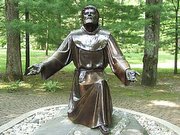
Francis reflects on the Lady Clare

Her hair lies in my hand. It is beautiful: long, blonde and gently curling. It was both a joy and a pain to cut it. Yet now, her hair is in my hand and her shorn head covered with a veil. It is a sign to all the world that the Lady Clare has chosen to dedicate her life to God, that she has rejected the wealth and the nobility that were hers until a few minutes ago, and still could be should she regret the step that she has taken.

Yet I believe that something very rare and beautiful has happened, something that I find hard to put into words. I truly believe that God has touched her heart and has called her to himself. I truly believe that God has asked her to count everything as loss compared to the true riches of knowing and loving him.

Clare’s heart is like a garden filled almost to bursting with beautiful flowers. I can think of no better description, for what is more lovely than a flower…or birdsong…or the sun…or the moon…? It is difficult to draw an exact comparison because if I reflect on one aspect of Creation that speaks to me of my Lord, I think of another which is just as beautiful in its own way. Is it not amazing the way in which the whole of the Universe is merely a reflection, and a poor one at that, of the Father who made them?

I confess to feeling somewhat confused. How could I have dreamed that in my own following of the Crucified and in falling in love with my dearest Lady Poverty, that others would be drawn to a similar path? I had never planned to attract followers, especially not someone like the Lady Clare, and yet, if I think of the magnetic wonder of the words of my Lord, how could others not feel drawn to him? If the Lord is choosing me as an instrument, then so be it, but he has certainly chosen the weakest, humblest, smallest and most unworthy tool in his entire collection.

Lady Clare. If I think of her, I also think of my beloved Lady Poverty. Are the two one and the same? No, for Lady Poverty was with Jesus even on the Cross. When he was fastened there, so was she. If anybody was truly Lady Poverty, then who could match his mother? Yet Lady Poverty was even more than she, much as she was uniquely blessed. Whereas Mary’s heart was with Jesus on the Cross, Lady Poverty was holding her in her embrace and, at the same time, was entirely nailed to the Cross with her Lord, pierced by the same nails, experiencing the same sense of destitution and rejection by the very ones whom he had loved so dearly.

Yet Clare also has a feeling for Poverty. If she did not, then how else could she have left her family and all the comforts of her station?

Now, as I kneel before the Crucified here, in the little church of San Damiano, I remember the moment when he spoke to me and told me to rebuild his Church, which, as I could see, was falling into disrepair. At the time, I thought he meant only to find stones to replace those that had fallen to the ground or had been carted off for other purposes.

If the Lord is sending me followers whom I have not sought, is he perhaps asking for something different? If he is calling others to search for him in the company of Lady Poverty and has even called the Lady Clare, what is he saying? Is he inviting us to something beyond a physical building? Is he calling us to a deeper union with him through the Gospel? How do we find out what he is saying? How do we follow him on a path that is untrodden but on which he has also blazed the trail?

Lord, teach me what I should do. Teach us to be open to all that you are telling us in our hearts.

God bless,
Sr. Janet

Saturday, November 10, 2007

Clare considers her future


He is just a young man from the other side of Assisi, a failed soldier, a youth who has helped to build the defensive walls around the city in order to protect us from the attacks of the Perugians. We have never even spoken to each other. We are of a different class altogether: he, the son of a merchant and I, the daughter of an ancient noble family. Yet why do I feel so drawn to all that he says and does? Why do I find myself listening to the gossip of the servants and of the visitors who pass by our house? Why do I find myself hoping to catch a glimpse of him as he walks through the town, dressed as a beggar and asking for stones to rebuild the ruined church of San Damiano, some distance down the hillside? Why do I find myself walking in that direction, often without planning to do so, but my feet seeming to have a will of their own?

The tapestry needle has fallen still in my hands, which are also now motionless on my lap. My thoughts are far from the design that I have been creating for so long.

It is strange. Even a young girl such as I, hidden within the care of my family, could not but hear of the young man, Francesco Bernadone. I heard the story of how he went out to fight a battle, dressed in costly armour, and then returned without even drawing his sword to fight. There were so many critics who called him a coward and bade him to put his money where his mouth was, for before he set off, he had long been boasting of his aim to become a famous knight.

Yet he did put his money exactly where his mouth was: he stripped himself naked in the Square and returned his fine clothes to his father. “Hitherto I have called Pietro Bernadone ‘father’. From henceforth I have only one Father: God”. I heard of how the bishop covered Francesco with his own cloak.

The townsfolk were scandalised. Even Bernadone’s enemies felt pity for him when they saw the anguish in his face. As for the Lady Pica, there was not a woman in Assisi who did not want to embrace her to soothe her heartbroken sobbing.

Yet, although I also felt the agony of the parents, there was something about Francesco’s gesture that made me long to follow him and do the same. Not, of course, to stand in the Square in my nakedness, but, yes, for my heart and soul to be naked, open before the Lord who also seems to be calling me to something I cannot yet define. There is something about the actions of Francesco that fan to a burning brightness the little ember that has been burning inside my own heart.

What should I do? I cannot follow Francesco into the woods. What would people say? Yet, at the same time, when he speaks of having fallen in love with Lady Poverty, he makes me think of my Lord, who was truly poor and who was so tender and caring to all those who were suffering.

I have tried to do all those things that I feel my Lord would be asking of me. I take food from the kitchens in order to feed the lepers. I send food down to Francesco and his companions as they work at San Damiano. I try to be kind and charitable to all. I spend long hours in prayer and yet I still feel as though I have done absolutely nothing with my life. Somehow it is as if God is not satisfied with my efforts. It is as if, until now, I have only given him a part of myself whereas he wants my whole heart and my whole soul.

What should I do? Would it help if I were to speak with Francesco? Would he accept me as a follower as he travels towards the Lord? How would he advise me? He has fallen in love with his Lady Poverty and has divested himself of everything except his desire for total unity with her. Francesco would understand. My heart belongs to God. I want my body and soul to also belong totally within the loving embrace of my Lord.

Will Jesus speak to me through the words of Francesco?

God bless,
Sr. Janet

Wednesday, November 07, 2007

The last lotus


This following story, taken from the poem ‘Fruit-Gathering’ by the Indian poet Tagore, is something I found so beautiful that I had to share it. It might not be Christian, but as with so much of his work, it is so easily Christianised.

God bless,
Sr. Janet


Sudâs, the gardener, plucked from his tank the last lotus left by the ravage of winter and went to sell it to the king at the palace gate.

There he met a traveller who said to him, "Ask your price for the last lotus, -I shall offer it to Lord Buddha."

Sudâs said, "If you pay one golden coin it will be yours.

The traveller paid it.

At that moment the king came out and he wished to buy the flower, for he was on his way to see Lord Buddha, and he thought, "It would be a fine thing to lay at his feet the lotus that bloomed in winter."

When the gardener said he had been offered a golden coin the king offered him ten, but the traveller doubled the price.

The gardener, being greedy, imagined a greater gain from him for whose sake they were bidding. He bowed and said, "I cannot sell this lotus."

In the hushed shade of the mango grove beyond the city wall Sudâs stood before Lord Buddha, on whose lips sat the silence of love and whose eyes beamed peace like the morning star of the dew-washed autumn.

Sudâs looked in his face and put the lotus at his feet and bowed his head to the dust.

Buddha smiled and asked, "What is your wish, my son?"

Sudâs cried, "The least touch of your feet."

Monday, November 05, 2007

Still the same


Its ceilings and walls are covered with symbols that would be recognised only by the Christians who slipped into the villa from the street. From the outside, nobody would know that the house was used as a church. Images of twisting vines, baskets of bread and fish, doves carrying olive twigs, dolphins and anchors, a banquet, a typically Roman matron with her son on her lap, a shepherd with a lamb draped over his shoulders, flowing streams, men collecting rainwater as it poured down in torrents from the sky, a group of seated people eating an al fresco picnic of bread and fish… who would know that each was a symbol with a meaning that today, two thousand years after they were first painted, we still have not plummeted to the depths?

Situated on the perimeter of the Forum, was this house church active when Peter and Paul were imprisoned in the Mamertine, literally only a seven-minute walk away? Might the owners of this house have been amongst the very first recipients of Paul’s letters, written in that same prison? Might they have been responsible for preparing and delivering food to the incarcerated Apostles? Was this a house where the Apostles themselves were familiar guests? Did Peter and Paul drink water from the two wells still clearly visible (and functional if their protective covers were to be removed)?

Before ever there was the freedom to build churches, this was one of the houses where the remains of martyrs were brought and kept with love: Philip, James, Denis… That is why the church that, today, houses the villa is more than worthy of its name of The Most Holy Twelve Apostles (Sanctissimi Dodici Apostoli), for how many left this house only to find themselves prisoners and the intended victims in the Colosseum, a mere half-mile away? How many came here to find some comfort after their friends and relatives received a death sentence and were executed after unspeakable torture?

How many non-Christian visitors to the house would have realised that they were seeing scenes of the Good Shepherd, whose death on the Cross was too horrible for the early Church to portray? Would they have known that before their eyes was a scene of the feeding of the Five Thousand, or the Living Water that had come down from Heaven? The Last Supper, especially with only seven men gathered around the table (seven being a ‘perfect’ number with mystical significance) would have been beyond their understanding.

But what about the woman and the baby? That was easy even for a pagan to understand – or was it? There are two images in which the woman and her son are identical except for size. Both are clad in white robes on which a broad blue band extends vertically from shoulder to hem, and yet, even then, there is a difference. These are not mere pictures: they are statements of faith in the Incarnation. It is not a coincidence that the smaller of the two scenes shows the mother and child receiving caskets of gifts from three foreigners… the Magi? This is a very, very early Nativity scene!

Neither is it a coincidence that the larger picture is merely a handspan above the altar under which were placed the remains of the martyr, Denis, in an alcove in which one or two of the tombstones are marked with the strange (to an outsider) markings of a palm, a dove or a chi-rho.

The artists died centuries ago, never knowing that their devotional images, providing not only decoration but also instruction to the illiterate, would also teach us, the continuity of all that we believe today. The Gospel stories are unmistakably there for us to see in freedom and without fear of our lives. Their narratives also show us something else that is intrinsic to life today.

From the very earliest days of Christianity, a woman was honoured only in second place to her Son. A woman was deliberately painted over the tombs of martyrs even if they were men who had died. A woman is shown receiving tribute on behalf of her Son, a woman who, in a marginally older fresco on the other side of Rome, is shown, again over an altar in her honour, receiving food and drink from the midwives who had just helped her give birth to a Son.

Mary, you were there, at the very beginning of the Church, giving hope and courage in the face of unspeakable risks. Be with us today. Two thousand years later, we still need a mother.

God bless,
Sr. Janet

Sunday, November 04, 2007

Who would have thought that God could be found so easily?


Who would have thought that God could be found so easily?

Walk on the path and look upwards, through the branches, through the leaves of the trees along the way. See the blueness of the sky pierce the gaps, the sun reflect on the leaves as they shimmer in the breeze and there is the mirrored face of the Lord who created them. Watch as, through the year, the stark twigs gradually become green, slowly mantled in loveliness, a beauty that changes as the days and the months go by. The colour of early Spring is not that of Midsummer, or even that which hints at the forthcoming hues of Autumn. The russet and gold that, sun-kissed, set the hillsides on fire with their majestic tones, themselves give way to the bareness of Winter once more.

Yet, in each tree, is God. The tree is not God, but it is his messenger.

Who would have thought that God could be found so easily?

Listen to the silence, the real silence, born through a quietened heart. It is not without sound. There is the melody of the birdsong, each species with its own unique melody. Sometimes it is a chorus, occasionally, a solo. It is always a harmony, so that even the raucous crow plays its part. In the silence is a quietness that grows ever deeper until it pierces the soul. The universe becomes the song of feathered minstrels, most of them unseen.

In each bird is God, yet God is not the birds, which are merely his creations. Their orchestra is his messenger.

Who would have thought that God could be found so easily?

Stroll down to the water’s edge and watch the ripples catch the sunlight or the moonlight. Sunbeams and moonbeams dance on the surface, so utterly free that they fill the vastness of the sky, yet can still be trapped by a ripple and thereby bring heaven to earth. The sun and the moon both create their pathways on the water, and yet, if a foot is outstretched to tread their gold and silver, they disappear. Their roads are intangible, but they lead, unwaveringly, to a distant horizon by a path that always travels from the very point at which you stand, gazing at their loveliness. A moonbeam and a sunbeam can never appear together. One is of the night and the other of the day. One is gentle, the other pulsing with energy. Both embrace their own truth, touching the heart in their own unique way.

Who would have thought that God could be found so easily?

Look inside, past the clutter of daily life, to all that is most real. There, in the midst of your deepest longings, the loveliness of your beautiful qualities and talents placed there by a loving God, nurtured in the silence and solitude of stillness, that is where God is to be found. Perhaps you have had your difficulties in life, but whereas there have been the failures, there have also been the successes, perhaps unseen even by you. Yet God has witnessed them and has, through the stumbling and the efforts to make a new start, has drawn you even closer to himself.

Who would have thought that God could be found so easily?

God bless,
Sr. Janet

Friday, November 02, 2007

Right to life, right to die

Many people used to stop by my computer to look at the picture I had on the desktop. I was not surprised. I liked it myself, which is why I put it there in the first place.

The black and white picture showed a very new baby, held up in the air by two hands: that of its mother and father. The infant sucked its thumb, even in its sleep. Just above its little chest, a light glowed softly. The hands and the light seemed to say that there were three people involved in the little life, curled up in peaceful sleep: its mother, father and God.

Yet sometimes the wonder of life is trivialised in a world where so much is disposable that human life can also be put onto the rubbish heap.

Working as a midwife, mine was the privilege of being the very first person ever to have seen the baby emerging from its mother. There was a uniquely special feeling of being ‘in’ on the act of Creation. One of the most unforgettable joys of my life was when an unborn baby took hold of my finger and refused to let go.
Unfortunately, I had to release my finger from the tiny hand. After all, the baby had to be born and its hand was in the way, even if infinitely precious and in spite of my wanting to treasure that moment of closeness.

We hear a great deal today about the “abortion issue” and “the right to die debate”. Life is not an issue or a debate. Those who are doing all the talking can sometimes forget that they are only able to voice their opinions because they themselves are alive and that someone loved them into being.

Thank God that there are those who are willing to stand up for the defenceless.

God bless,
Sr. Janet

Thursday, November 01, 2007

‘Viva Christo Re!’

It was a chance remark that was not a chance. A Cuban Jesuit remarked that one of the 498 martyrs beatified last Sunday was a Cuban seminarian studying in Spain at the time when approximately 7,000, including two bishops, were killed in the country’s convents, religious institutions and seminaries.

“He was given the chance of returning to Cuba, but he said that he wanted to stay with his professors and fellow students even if it meant being killed. As he died, he flung up his arms and shouted, ‘Viva Christo Re!’”

“Long live Christ the King!”

This seminarian, whose name I do not know, was so young. How was it that in the few short years that were given him, he reached the point of welcoming martyrdom, turning down the possibility of safety in favour of staying with others whom he knew would also be martyrs? In the inevitable fear of the last few moments of his existence on earth, how did he possess such complete confidence in his Lord that his final words were a declaration of the importance of Jesus, not only in his own life, but, as Christ the King, also important to the whole world?

The decision to remain in Spain during a period of religious persecution, especially when given the chance of freedom and security in his own country, was one that was made in the cold, clear light of reason. Nobody makes such a choice on the spur of the moment. Nobody in their right mind chooses to throw away their own life when it is full of meaning and promise.

Did the young man not think that, if he were to return to Cuba, he could reach his already declared goal of priesthood? Did he not, even briefly, visualise the day of his ordination and imagine himself offering the Eucharist to the people who would attend his Mass? Did he not think of his family, friends and those whom he loved, whom he would not see again in this life?

Of course all those thoughts went through his mind, because if they had not, then he was no martyr: he was a fool who discarded his life in somebody else’s cause. If he were not fully aware of the consequences of his choice, then it was mindless. It was a waste, not a sacrifice, of his young life. He would have stayed with his companions, not because of solidarity in faith and commitment, but because he had followed the herd instinct that we see in cattle or sheep. He did not stay because he was unafraid because courage does not mean fearlessness. Courage means doing what is right in spite of fear. The reckless are not brave.

The decision to stay and face death was made in the cold, clear light of day. The young man did not choose to die, but if death were the consequence of a life given to his Lord, then so be it.

The new Blesseds died such a short time ago in 1936. Their relatives and friends were amongst the 70,000 in St. Peter’s Square. What were their thoughts? How many of the thousands present would have chosen to act in the same way as the young seminarian? We do not know. The vast majority of us will never be put to that sort of test. We are, however, all called to give our lives for Christ the King. That is why today is the feast of All Saints, those living and those who have died and have gone home before us.

‘Viva Christo Re!’

God bless,
Sr. Janet

Wednesday, October 31, 2007

5th Glorious Mystery: The Coronation of Our Lady in Heaven (Mary)


I am still only a young girl from Nazareth. I never sought any honour for myself, never looked for any of the honours that have been heaped upon me.

Never will I forget the days of my youth, of the laughter around the well as my mother drew water or chatted with her friends. It was a task that was soon to be my own for no household can survive without water and those brief moments in the middle of the village are the precious times for all women. They are the opportunities for a short rest from the daily routine of caring for the house and family, an occasion to meet friends, exchange news and share a lifetime of togetherness, for every woman knows every other woman in a small village such as Nazareth. Our lives are inextricably entwined. That is why village life is a wonderful strength and support, but when something goes wrong, the gossip can be unending and unendurable.

I felt great sorrow for my mother in that brief period before Joseph and I married. The women could see that I was pregnant, but if it was something that my mother had found hard to accept at first, so did the people in the village. There was the inevitable gossip. There were the snide comments that both my mother and I found hurtful. After all, neither of us could say what had happened. I could not tell the world that I had been visited by an angel. Joseph could not face the menfolk of Nazareth, telling them that he was not the father of my baby. I would have been stoned to death as an adulterer because, as Joseph and I were already betrothed, we were as solemnly bound to each other as if we were married.

Life became easier once Joseph and I were married. People then presumed that my baby was also his. The gossip soon died away as we lived the life of an ordinary married couple, with me looking after the house and Joseph continuing his work as a carpenter.

…and then Jesus came along. Yes, the journey to Bethlehem was difficult, especially as I went into labour and gave birth to Jesus in a stable, but the innkeeper’s wife was very kind to us whilst we were there. Even as we escaped into Egypt, knowing that we were trying to escape from Herod, as we passed by the inn, she ran out, pressing food into Joseph’s hand.

Joseph and I were happy to return to Nazareth from Egypt. By then, Jesus was walking. He was such a happy child, a real treasure. We loved watching him take his first steps, stumble and fall, and then pick himself up again. Yes, there were tears if he hurt himself, but what toddler learns to walk without a few bumps and bruises?

It was not long before Jesus was a boy, playing with his friends, accompanying us to the synagogue, ‘helping’ Joseph in his workshop, finding countless ways to satisfy his lively intelligence and abundant energy.

Then Joseph died. Jesus became the head of the household and so it was his job to lead the mourning for the man who had been everything that a father should have been to him. Nobody would ever have known that Joseph was not the father of Jesus. He was such a caring, loving, wonderful, man. We loved him so much. I thought I would never come to terms with not having him at my side…

I had always known that Jesus would grow to manhood and would move away from Nazareth, following the path that his Father had chosen for him. My life was often lonely in his absence, especially when I heard of both, the joys and the sorrows of those three years. I cannot begin to describe what his arrest, crucifixion and death meant to me, cannot begin to express the agony of that day, an agony that left a lasting mark even when I had seen him after his resurrection.

…and now, Jesus and I are together again, forever. Joseph and I are together again, forever. Heaven is togetherness.

God bless,
Sr. Janet

Tuesday, October 30, 2007

4th Glorious Mystery: The Assumption (St. John)


I am not sure what I should think. I was present on the top of the mountain when Jesus, having talked to us for some time, gradually began to ascend towards heaven and, slowly but surely, disappeared from view. An angel asked us why we were staring into the sky after One who was no longer with us on the earth, but I ask you, what would you have done in the same situation? You would have been staring, too. Nothing in the whole history of the human race has ever equalled the event that we witnessed.

…and now, there is something else that has happened that is just as strange.

Mary has been living in my house ever since Jesus died on the Cross. She has looked after me as a mother, and I have cared for her as a son. That was what Jesus asked of both of us, but I am very certain that we did not need to be asked. We would have cared for each other in any case because of our special relationship with Jesus. How could I not take his mother into my home and do for her all that Jesus could not? Knowing that I was bereft at the death of Jesus, Mary, as the wonderful mother that she is, saw that my pain was merely an echo of her own. No mother wants to see a child die as hers did, and so she took it into her head that she would ease my own suffering by taking it upon herself.

Then there was that amazing moment when we saw Jesus in the Upper Room and heard him speak once more. That was a delight beyond anything that I can ever describe. He had been truly dead. Mary and I had both seen that and we were there as he was placed in the tomb, so we knew that we were not losing our minds or imagining things that were merely products of our fevered imaginations. Jesus was really and truly with us and stayed with us for the following forty days.

Of course we felt lonely when Jesus left us and ascended into heaven. You would have felt just as we did. You would have been as reinvigorated and changed as we were when the Holy Spirit came and sat upon our heads in the form of parted tongues of flame.

Mary lived in my home for some years. We moved from time to time, but that was inevitable, especially when it was necessary to avoid some of the persecutions that were inflicted upon those of us who chose to follow Jesus. I was perfectly prepared to suffer the same fate as the other Apostles, but I wanted to keep Mary safe and so I avoided some of the worst troubles. Not that I escaped without any incident. After all, they did try throwing me in boiling oil at the Porta Latina in Rome, but I was unhurt and managed to escape yet again.

…but I am digressing. My confusion is because having seen the ascension of Jesus into heaven, I think I have just seen something similar insofar as, a few minutes ago, Mary was plainly dying. It was peaceful and serene, but she was dying. I watched as she drew her last breath. Yet now, instead of her beloved body, there is an empty bed and the fragrance of roses. Just as I watched Jesus ascend, so I have just seen Mary imitate her Son, even in this.

Is it any wonder that I am confused?

God bless,
Sr. Janet

Sunday, October 28, 2007

3rd Glorious Mystery: The Descent of the Holy Spirit


My heart is burning within me. A few minutes ago it was tight with fear and I was jumping at every sound. A few minutes ago, we were all sitting quietly in the room, half-expecting, at any moment, to hear the tramp of heavy footsteps pounding their way up the stairs towards us. We were expecting the inevitability of a fist banging the door, a gruff voice and the entry of an armed guard. The anticipation of bound hands and of an ignominious parade through the centre of Jerusalem was something that seemed unavoidable. For all of us, there was a flesh-crawling fear of having the clothes stripped from our backs and, where the flesh is unbroken and tender, of metal-tipped flails lashing their way through skin and muscle, of once peacefully-coursing blood spattered on the surroundings. Having seen those who had been scourged, there was the sick ache in the pits of our stomachs with the dawning realisation that this fate would be ours. Was it any wonder that we huddled together in fear?

Yet now, everything is different. I want to throw open the windows, unbar the door and burst out of this self-imposed prison. I want to sing and dance for joy even though I am tone-deaf and my dancing is unbearable even to myself! I want to throw wide my arms to embrace the world. Such a change in such a short time!

No. I am not drunk, and neither are my companions. We are not sick, unless feeling faint with happiness is a sickness, which I doubt. Where there was despair, we are filled with hope. The world is a new place. Instead of darkness, the sun is shining, but not just the sun that hangs in the heavens, a golden, burning orb. No. It is a sunshine of light and vitality that pierces even the blackest corners and fills them with promise.

After Jesus disappeared from us, we were afraid. We kept ourselves to ourselves, not straying far from the room where we felt safe because it was the very room in which we had shared our last meal with Jesus. It was the women who were courageous. They brought us food and water, kept us alive. At night we merely pulled our cloaks around us and slept on the floor or on benches. It was uncomfortable, but we did not want to draw attention to ourselves, even by finding sleeping mats. If we had to leave the room at all, it was briefly, silently, with as rapid a return as possible.

Yet now, all is changed.

There was a sound that filled the air. We were afraid and yet not afraid, for although it was something we had never heard before in our lives, it was not the sound of a wind that would cause the devastation of a mighty storm. It was a wind and yet not a gale. That might sound a contradiction, but I am not sure how else to describe what happened.

The wind entered the room where we were hiding. How? I do not know for we had the windows tightly closed and shuttered lest they betray our presence. Yet somehow, that wind still managed to find us. In its midst was a fire, a burning fire that hovered mid-air,. Have you ever seen a fire that has no fuel, that is hovering above the ground? Can such a thing exist? Certainly not in normal life, but our situation was not normal.

The fire, as we watched, broke up into several small flames. Each flame moved through the air and hovered over the head of one of us. Can you imagine a group of men with a flame above his head? No, we could not have imagined it either. Yet that is what happened.

…and now, the fear has gone, to be replaced by peace. Instead of being trapped inside ourselves, inside the room, we are free, free to go anywhere, do anything. The fire is within, burning, consuming, destroying all that had kept us prisoners within our own hearts and souls.

There is a new spirit within, a Holy Spirit…

God bless,
Sr. Janet

Thursday, October 25, 2007

2nd Glorious Mystery: The Ascension


It is almost as if the world has emptied itself. That might sound a strange way of talking about what has just happened, but it is the only description that comes to mind. The world is suddenly silent, even with the birdsong, the breeze and the incessant noise of the cicadas as a background to our thoughts.

We all stood in soundless stupefaction, not knowing what to do, not daring to speak. We were suddenly enveloped in silence. We were still and yet only because immobilised in confusion.

A few minutes ago, Jesus had been with us, talking and chatting as we strode up the mountain. We sat around when we reached a suitable resting place, and merely chatted about anything and everything. The sun was pleasantly warm and we were in no hurry. The day stretched ahead of us, or so we thought, because I think that everybody possibly felt as I did: that there was something immensely important to Jesus, something that would touch our whole future lives.

I am not sure at what point our conversation became serious. Was it a sudden or merely a gradual change? I cannot say. Looking back, it seems as though at a common moment we tired of trivialities. The commonplace of our lives appeared exactly what it was: commonplace, composed of the small events and often empty words and thoughts of small people.

Jesus did not demean us in our smallness. That is something he has never done, even when one or more of us had said or done something really foolish. On this occasion, ‘small’ meant ‘beautiful’. It meant finding ourselves in a position of receiving, for, all of a sudden, we all experienced such a spiritual hunger and thirst that I have no words that can convey the feeling. It was all-consuming.

It was at that moment that the words of Jesus took on a new character for we were listening in a way that had never happened in the three years of our wandering around Israel with the Master. Yes, we had learned much from him during that time, but now we hung onto every word as though it had to be captured for ever, as though this was our only opportunity to be with Jesus and to ask questions of him, hearing him respond in our own Aramaic.

It sounds strange, but for me, it was as if my chest had been bound with tight metal bands that, without warning, burst and allowed me to draw in a deep breath. It was if I was learning to breathe for the first time, as if each intake of air was something deeper than had ever before been possible. With every inhalation, it seemed as though I was absorbing the words of Jesus and making them my own.

It was an amazing experience. We felt ‘little’ and it was beautiful, because, in our littleness, we saw the greatness of Jesus and everything he was saying. We understood, perhaps for the first time, the importance of every moment that we had been together. It was as if our hearts and souls had been parched and were now slaked, as if we had been starving and were now no longer hungry… and yet with the satisfying of our hunger and thirst, there was also a yearning need for more, because our starvation and drought would never be fully satisfied.

All too soon, Jesus stood. We were surprised because we could have listened to him for ever. He spoke a few more words and then, to our amazement, he began to ascend into the heavens. Slowly, ever so slowly, he rose above us. An opening appeared in the clouds…and he was gone! He had disappeared!

How does someone disappear? Where had he gone? Jesus, does this mean that we now have to live out the rest of our lives without your presence? What did you mean when you said that you would be with us until the end of time?

God bless,
Sr. Janet

Wednesday, October 24, 2007

1st Glorious Mystery: The Resurrection (Joseph of Arimathea)


I am astounded! I would not have given my newly-made tomb to Jesus, would I, unless I knew he was either dying or else was already dead. It stands to reason, does it not? Someone who is living does not need a tomb.

I was the one who went to Pilate to ask for the body of Jesus to be taken down from the Cross. I could not climb up myself to unfasten his hands from the horizontal beam: I am a bit old for that these days. Still, I was able to stand at the foot of the Cross and help as John and a couple of youngsters from my household lifted Jesus from his gibbet.

His mother was there, waiting. Can you imagine the pain as I helped to lift his beloved and bloodstained body onto her lap? She cradled him as she must have held him when he was a baby, softly crooning the old lullaby that she must have sung when he was tiny. She stroked his matted hair and stiffened limbs, staining her hands with his blood.

Mary was in a little world all of her own, where there were only herself and Jesus. Perhaps Joseph was also present, but not before our gaze. Mary was dignified beyond belief, but her eyes were reddened and swollen as she sat there. She did not cry. Perhaps she had shed all the tears and none remained. Perhaps they would flow in the privacy of her room.

Her robes were also red as she relinquished her embrace of her Son, allowing us to carry him to my own newly-hewn tomb. I am one of the living, you see, who will soon need a tomb, and so I had been preparing for my own burial when I built the sepulchre, never knowing that I would be helping to carry a young man to lie on its rocky couch.

It was the eve of the Sabbath, so we did not have as much time as we would have liked to prepare the body of Jesus. We wanted to wash him thoroughly and anoint him with fragrant spices, but time moved on and the duties of the Sabbath, especially during the season of Passover, urged us to stop. After all, much as we dearly loved him, Jesus was dead. A delay of a few hours would make little difference. We could finish our labour of love once the Sabbath had finished. Reluctantly, John and I, with the help of the youngsters from my household, rolled the heavy stone across the entrance of the tomb and made our weary way home.

Now it is the third day and I stand at the entrance of the tomb once more. I can barely believe what I see, and I certainly do not understand the scene before me.

The heavy stone has been rolled away. There, on the slab, are the linen cloths we had used to wrap the body of Jesus. They have been carefully folded and placed neatly to one side, but the body of Jesus has gone.

The Magdalen told us a strange tale, saying that she met Jesus in the garden and mistook him for the gardener. She reported that he wanted her to tell the Apostles all that she had seen, which is exactly what she did, although they and I were more than a little sceptical. Nobody rises from the dead!

…or do they? I am beginning to wonder. Jesus was dead and dead men do not move by themselves. The story that the Magdalen tells us is more than a little unexpected, to say the least.

…but very little that Jesus said or did was ‘expected’. Has he, by any chance, come to life? How? What am I supposed to think? I do not know.

God bless,
Sr. Janet

Tuesday, October 23, 2007

5th Sorrowful Mystery: Jesus Dies on the Cross (The Good Thief)


He has died at last. I am glad for him. I also think he is fortunate. He can suffer no more. His pain is at an end whereas mine continues. Of course, he was beaten more than I was. Strange, though. Why has he died first? Perhaps it is a silly question because it will not be too long before I also die.

Crucifixion is a terrible punishment. It is so agonising. The Romans have refined its cruelty to a fine art. Who else would have thought of including a small wooden peg on the upright in order to help their victim lift himself slightly and draw a breath into tortured lungs? Can you imagine the torture of putting pressure onto nailed feet in order to relieve the excruciating pain in writs that have also been impaled by their nails? The Romans hammer the nails into the small space between the wrist bones, not only because the nails thereby pierced nerves, causing indescribable torment, but also, because the wrist bones can then bear the weight of the body, death comes more slowly. People do not bleed to death on a cross, not normally. That is why it is possible for them to hang there for several days, suspended between heaven and earth as a symbol of having been abandoned by God and by man.

Until now, I had never considered all that was suffered by those whom I saw crucified. Now I share their agony. I also know that as the Sabbath is dawning, the priests will not want our three bodies to remain on our gibbets. Jesus is already dead, but my companion and I live on, gasping for breath. People do not always realise that it is suffocation that kills on the cross, not the nails. As the victim hangs there, becoming progressively weaker, it becomes harder and increasingly painful to make the effort to lift oneself up that tiny distance that will make breathing possible.

My companion and I are still alive. The soldiers will have to do something to hasten our deaths. That is what I am dreading even more than the fact of death itself. I have already suffered enough. I do not want them to break my legs so that breathing becomes impossible. I do not want to suffocate. I want to live. I want to be whole and strong again.

How differently I would live if I had my time over. I would make different choices, wise in foresight, not in hindsight as I do now. I would ‘act justly, love tenderly and walk humbly with my God’. It was mere greed that led me to a life of crime. I never saw, really saw, the effect on others of my actions. For sure, I saw with my eyes what I had done, but I did not see with my heart, and that makes all the difference. If I had learned to see with my heart, I would see the troubles of others and would be sympathetic to their struggles as they try to live through each day.

Jesus could see with his heart. That is why he was different from other men. He could see with his heart…almost as if he had eyes in its pumping, warmth. That is why he knew what it was to be compassionate, sympathetic, understanding, caring, forgiving…all the things that I never was.

Yes, my companion and I deserve the punishment that we have received. We both did wrong. We only ever learned to love ourselves, not others and, in our selfishness, never used our hearts as organs of true sight and insight. We are here on our crosses, nailed here by our own selfishness.

Yet Jesus, even in the extremes of agony, could see others and feel for them. His own pains did not mask those of others. I saw him provide a carer for his mother. I watched him give a mother to his orphaned friend. Even though bystanders taunted and mocked him, he prayed for forgiveness for them. How could he have been so generous and forgiving?

His words pierced my heart with a sword sharper than any carried by a soldier. I turned to Jesus, perhaps still selfish, because I asked for myself, yet perhaps, for the first time in my life, seeing things as they should be. “Jesus, remember me when you come into your Kingdom”.

He slowly turned his head towards me, his eyes filled with pain, pushing himself upwards so that he could breathe and speak to me. “This day, you will be with me in Paradise.”

“Jesus, remember me when you come into your Kingdom”.

God bless,
Sr. Janet

Monday, October 22, 2007

4th Sorrowful Mystery: The Carrying of the Cross (Pilate’s wife)


No good will come of this. I told my husband that I have been much troubled as a result of my dream about this man, Jesus of Nazareth. As usual, Pontius only partly listened. I scared him, though, that I will admit. He is a weak man and given much to enquiring after omens and soothsayers. He is a weak man and is easily led, easily cowed by the fear of imagined consequences.

What would have happened if Pontius had found Jesus innocent of the charges laid against him? Surely, even if the High Priest had complained to Caesar, then my husband could have found some way of demonstrating the falsehood and self-interest behind their claims? For sure, there have been those who have set themselves up against the Roman occupation of Israel, but they are foolish. Can they not see that, whilst taxes may be high, the real extortionists are their own tax collectors, who levy their own surcharges over and above those of Rome.

My husband declared that he found no fault in the carpenter from Nazareth, but he would have him chastised in any case. Fool! Did he not see that this was a complete contradiction in terms, not realise that he went against the rightfulness of his own authority? Who chastises an innocent man? He gave the High Priest a rod with which to beat him. He will suffer for this action and I, as his wife, will also feel the consequences.

As I stand at the window of my room, the crowd below cannot see me, but I can see them and hear them. I can hear their cries of “Crucify him! Crucify him!” Do they not understand by destroying innocence, their guilt is compounded? They tell Pontius that the blood of this man will be on themselves and on their children. So be it. However, they do not understand the implications of their words.

As for Jesus, I was horrified when I saw him. Living here, I have often seen the victims of scourging. It never ceases to fill me with a mixture of dread and pity. How could my husband be so cruel? I know he is heartless and venal. How could I, as his wife, not see at least some of the crimes that he has committed and explained away? Yet to condemn this harmless Galilean who has spoken so often and so wisely was the height of folly and of cruelty.

“Behold the man!” The crowd saw him and gasped. Some of them were touched and turned away. They knew the innocence of Jesus and were rightly ashamed that their catcalls and willingness to be led by a few of the agents of the High Priest had led to the humiliation of a good man. Yet in his weakness, Pontius was pitiless in spite of my warning. He called for water and washed his hands. How could he!

Jesus was led away from the sight of the crowd, yet not from my own line of vision. I watched as the crossbeam was laid on his torn and bleeding shoulders. I couldn’t miss his cry of pain as he felt the full weight of the wood. He is so weak. Will he make it to Calvary, I wonder?

Calvary is so near and yet so far.


God bless,
Sr. Janet

Sunday, October 21, 2007

3rd Sorrowful Mystery: The crowning with thorns (a servant)

My wife is not going to be happy when she sees me. I have torn my tunic and, with a new baby in the house and several small children, she does not have time to do unnecessary mending on my behalf. It would be different if we could afford to have a couple of servants, or even slaves, but I am a poor man and cannot afford to feed an extra mouth on the pittance I receive from Pilate. In any case, how often does a servant have a servant? Not very often if, like me, he has a hand-to-mouth existence.

I try not to make extra work for my wife. I love her, which is unusual in most marriages these days. They are civil contracts made for convenience and for uniting families rather than hearts. Still, ours was a love match and still is. I am sorry that she must work so hard to look after our home and family. I am sorry that I seem unable to compensate her in some way.

Now, I have a torn tunic that she must mend. I did not intend to be careless, but one of the soldiers sent me to collect a bundle of thorns. He had the strange idea that, since the man whom they were flogging was known as ‘the King of the Jews’, he would crown him. He thought of the thorn bush growing outside the courtyard in the garden where Pilate likes to meet some of his cronies, and, since Pilate was otherwise engaged at the time, the soldier sent me to do some untimely pruning of the thorns.

It was not a large bush, nor a significant one. However it was native to this area and known for its long thorns, an ideal deterrent to grazing sheep and goats. The pliability of the twigs made them perfect, if that is the word to use for such a terrible deed, for entwining into a crown. It was fearsome. It was difficult to cut the twigs and even more so to weave the crown. That is how I tore my tunic. I also tore my thumb, but that will heal in its own time, although the blood on the tunic will just add insult to injury as far as my wife is concerned.

I had hoped that the soldier would have changed his mind when I returned. Some hope! He called me to his side and berated me for taking so long to execute his orders. It was alright for him. He had not dealt with the thorn bush! Neither did he take hold of the crown of thorns.

The soldier took one look at the crown and ordered me to place it on the head of the man they had just finished scourging. I saw the look of mortal fear in his eyes as I approached. It is something I shall never forget. I tried to balance it lightly so that he would not be injured any further, but the bloodlust of the soldiers had not been slaked. I had miscalculated the depths of their cruelty. Abused themselves, they showed little mercy towards prisoners. They used the butts of their whips to force the crown of thorns deeply onto the head of their victim. He cried out in pain. Tears of blood coursed their way down his head and face. I turned away, sickened.

Now I must return to my wife and offer her my torn tunic, but, really, it is my heart that is torn. I will never forget the sight of the fear in that man’s eyes. Although unwilling, I participated in the bestiality of the soldiers. Am I as guilty as they?

God bless,
Sr. Janet

Thursday, October 18, 2007

2nd Sorrowful Mystery: The Scourging at the Pillar


My arm aches! It always does after a scourging. Our senior officers do not consider us at all. How would they like to conduct a flogging on an empty stomach? It is a messy and thankless job which often ends up with a corpse needing disposal when the scourging is over. Added to that, there is always a mess around the area of the post and someone is given the job of cleaning up afterwards, that someone often being me because I am one of the youngest in our squad. Sometimes the centurion decides not to have the courtyard washed down because the appearance of the place then strikes fear into other would-be miscreants. It is a little bit of a deterrent to bad behaviour, but not much. If someone is determined to do something wrong, they will do it. On occasion, the victim has committed no crime other than to catch a senior officer on a wrong-footing.

Today, the prisoner was a Jew who had been sent by the High Priests. They tried to escape responsibility by sending him to Herod and to Pilate, but those two old foxes saw through their tactics.

Pilate declared to the crowd that he could find nothing in Jesus that merited death, but he did not thereby release him: he ordered us to flog him. Is that not a contradiction in terms? Why scourge someone after announcing that he is innocent of any crime? That is inconsistent and unjust. Washing his hands of Jesus did not absolve Pilate from guilt. He attempted to wriggle free of his responsibility by offering the mob a choice. They could condemn either Jesus of Nazareth or Barabbas, a brigand, but they, not Pilate, would have passed judgement

The Jews were clever. They had agents provocateurs in the midst of the crowd. They knew the one threat that would cause Pilate to tremble: they claimed that Jesus had set himself as a king and they owned no king but Caesar. Even I saw Pilate blanch when they made this utterance. He had to act against Jesus lest Caesar act against him.

I had seen Jesus around Jerusalem. He did not appear too dangerous even if he was always surrounded by a crowd. He looked even less of a risk after his robe was removed, leaving him standing defenceless. I almost felt sorry for him as my colleague fastened him to the post…. almost, but not quite. I suppose I must have become hardened after the number of times I have been called upon to flog someone. It is different when the prisoner is a fellow soldier: then there is a chance that we have shared the same barracks, camp fire and campaigns. Then I can identify with the pain and the indignity.

If the captive is a stranger, then it is not so bad. I can shut off my mind, so to speak, and busy myself with the task in hand. It is difficult because the screams are the same as the thongs bite their way into naked flesh. That is why it takes time to harden oneself.

Today, attention was focussed on Jesus of Nazareth. I was sorry about that because he appeared harmless and even Pilate recognised his innocence. He was here because of the venom of the High Priests. That is all. Sheer spite and expediency brought Jesus to Pilate. I watched Jesus huddled over the post, but we were tired and allowed him to rest there for a few minutes whilst our aching arms recovered.

But now, we have finished for the day. I can at last rest my aching arm.

God bless,
Sr. Janet

Wednesday, October 17, 2007

1st Sorrowful Mystery: The Agony in the Garden (John)

It is quiet now, but it is not an easy stillness. A few minutes ago I sat against the trunk of an old olive tree, alternately dozing and listening to the sound of the cicadas, the owls and the breeze as it rustled the leaves above my head.

A few minutes ago? A lifetime ago!

Jesus had asked us to stay awake when we came to the garden. He wanted to go deeper amongst the olive trees in order to pray. I tried to stay awake. We all did. The trouble was that a large Passover meal, wine and the quiet stillness of the moonlit night was not conducive to wakefulness. We all slept.

It was Jesus who roused us, telling us that we could now sleep. That contradiction did not strike me at the time because there were strange and unfamiliar noises: a horse’s bit chinking, feet tramping through long-dead leaves, furtive whispers.

Suddenly a group of armed men burst into the clearing, Judas in their midst. That was a shock. I had not expected to see him. All of us had thought he had left the supper room in order to give some alms to the poor. How could we possibly know that he had left us in order to meet with Temple guards? Why had he met with them? What was happening?

With a sense of horror, transfixed and unable to move, I watched Judas break free of the crowd and approach Jesus. At first, he was tentative and almost shy. He suddenly accelerated his pace and strode towards Jesus as though there was something he wanted to say or do that he needed to finish as quickly and decisively as possible. Nothing led me to expect Judas to kiss Jesus in greeting.

I was positioned directly across from Jesus so I could not avoid seeing the look of hurt in his eyes. “Judas, you would betray your master with a kiss?”

Judas had the grace to recoil in shock as though he had suddenly realised the enormity of his actions. He stood by, appalled, as the soldiers and Temple guard marched forward, grasping Jesus by the arms and tying his hands behind his back.

Peter was wide awake. Ineffectual as on so many occasions, he took out his sword and cut off the ear of the High Priest’s servant. Of what use was that? Yet even then, Jesus was true to himself, stooping to pick up the bloody ear and fix it back in place on its owner’s head.

Jesus performed a miracle for one of his captors! Is there anything about him that is not utter goodness?

How could Judas betray someone so loved by us all? Where did he find the courage, if that word could be so used, to seek out the High Priest and offer to hand over his friend? Was his greed so much more than his friendship, or was there an underlying motive that none of us can see?

The mob led Jesus away, taking him to Caiaphas. I must go to find Mary. How do I break the news to her? How does anybody tell a mother that an innocent child is probably starting out on a path to a travesty of a trial in which the first victim is truth and the second, justice? How will she face this agony that I must inflict? How can I soften the blow? I cannot think of a single word that will not inflict indescribable pain on someone who has done nothing to deserve it.

Eternal Lord, be with me. Be with Mary. Be with Jesus. Calvary is geographically so near. Now it is also close in time.

God bless,
Sr. Janet

Tuesday, October 16, 2007

5th Luminous Mystery: The Institution of the Holy Eucharist (John)

It was a sacred moment. We had all shared the Passover meal, an annual event that is so sacred and so much a part of our lives and tradition that all of us almost know the ritual by heart, with little or no need to prompt.

I was the youngest there, and so, as custom dictates, I was the one to ask “Why is this night different from all other nights?” By right, Peter, being the eldest, should have responded with the story of Moses and the escape of Israel from the might of Pharaoh and slavery. However, it was the seniority of Jesus that overtook all other precedents.

Jesus started the story. He has a pleasant voice, making it easy to listen, even at length. When he is speaking to the crowds and also to us, he might refer to concepts that are difficult, but his words themselves are not complicated. He is a born story-teller. As he spoke, each of us could readily imagine Moses, Aaron, Pharaoh and all the other characters mentioned in the course of the long history of suffering experienced by our people during their time in Egypt.

Of course, Peter, James and I had the unexpected benefit this year, of having seen Moses for ourselves. That memory made my mind wander away from all that Jesus was recalling to our minds, because I could once again visualise him on the mountaintop, where he glowed with an other-worldly splendour. I am sure that it was exactly the same with Peter and James. Did Jesus mean us to remember that moment? I do not know and it is immaterial, in fact.

The Passover ritual is so familiar that it was something of a shock to all of us when Jesus departed from its time-honoured format. Even those who had been feeling drowsy were suddenly alert.

Yes, we had the four cups of wine as prescribed for the occasion. We had the unleavened bread and the bitter herbs.

What we had not anticipated was that Jesus would take the bread, bless it, break it and share it amongst us, telling us that it was his body, which would be broken for us.

We had not foreseen that Jesus would take a cup of wine, bless it and would share it as ‘the cup of [his] blood, poured out for us in remission of our sins’. That was new and unscripted. What was he saying? We did not know and could not guess.

We did not feel that Jesus had taken anything away from Passover by his unfamiliar, unexplained, words and deeds. We all thought that, even if we did not understand, there was something very sacred and innovative happening. It felt like a new beginning even if we did not know what it might be that we were inaugurating. Do what in remembrance of him? Offer the bread and wine? Why did he say those words as if he were to leave us? It was strange and I still do not understand.

We had all eaten more than enough and needed some fresh air and exercise. It was Jesus who suggested that we leave the supper room and stroll to the Garden of Olives, a place much loved by all of us. I do not know where Judas might be. Still, he will probably guess where we are and follow on afterwards.

Thaddeus and I linger for a few moments, chatting in a desultory fashion, both somewhat perplexed by the change of sequence in celebrating Passover, but neither of us having the energy, at this time of evening, to enter into any debate. It is a warm, starry evening. All is well with the world.

God bless,
Sr. Janet

Monday, October 15, 2007

4th Luminous Mystery: The Transfiguration (Peter)

To be honest, I felt a bit stupid. I was curled up on the ground in terror and yet, when Jesus spoke and I looked up, he was the only person there, apart from James and John, of course, and they were making fools of themselves just as I was. Jesus must have thought we were real idiots up there on the mountain, surrounded by nothing much other than mountain, and yet quaking in fear.

Of course, things were a bit different only a few minutes ago. I really do not know what to say or how to describe what happened. You will probably think that I am just rambling on and that I must have actually fallen asleep and begun to dream, but I promise you that I was awake. I kept pinching myself to make sure that I was not sleeping, I promise you. In any case, James and John were every bit as stupefied as I was.

You see, the four of us had strolled up Tabor, chatting amongst ourselves and enjoying the mildness of the afternoon. We knew that Jesus wanted some peace and quiet for prayer, so after we had eaten, we quite happily relaxed on the warm slopes. We soon began to doze, but something made us sit up suddenly. I am unsure whether there was a sound because I can remember nothing.

All I know for certain is that when we sat up, Jesus was still there, but he was talking to two other men. I have no idea how I knew that the two newcomers were none other than Moses and Elijah. Their clothes were similar to those that we are wearing, but there was something about them that was different. They did not glow: that would be an exaggeration, but there was a glow about them. It was not light and yet it was light. How can I explain that? I have never seen anything like it and do not have the words to express what I saw with my own two eyes.

Then I looked at Jesus and truly did not believe my eyes. He was the same as always, but his robe was whiter than anything I could possible imagine. They were beyond white, if there is such a thing. They shone with a brilliance beyond the powers of any earthly bleacher to produce. Yet the brilliance did not dazzle. It was so strange.

Jesus himself also glowed, but beyond that which I could see in Moses and Elijah. The best way I can describe it is to say that if you think for a moment of someone who is extremely happy, then that person is radiant. Well, that is the sort of inner light that Jesus contained within himself…a happiness that was deeper and so far beyond anything on earth that it was truly ‘other-worldly’. He had become truly radiant, whilst remaining himself.

Moses and Elijah were speaking to Jesus, but not as superiors to an inferior, not even as equals. These two great men addressed Jesus as though they were infinitely subordinate to him…to Jesus, who travels in my boat, helps me to pull in the nets, shares my bread and fish, and sleeps on the ground along with the rest of us. Jesus is just ordinary, is he not? Why should Moses and Elijah speak to him with such deference?

But is Jesus ‘ordinary’? He does ‘ordinary’ things for sure, but he heals people, gives comfort to those who are distressed in any way, knows what is deepest in a person’s heart and is generous beyond anything I have ever seen or experienced. Yes, he is extraordinary, but not in a way that diminishes anybody. He treats others with such reverence and care.

I looked up and saw ‘only’ Jesus. He was as I have always known him. He had not changed, but I had. Perhaps four of us were transfigured on the mountain: Jesus let us see his reality. For James, John and me, it was a decisive moment. We could never again be the same. From now on we will continue to deepen our friendship with this carpenter from Nazareth, but our questions will be on a totally different level. He is growing greater whilst we are growing smaller!

God bless,
Sr. Janet

Sunday, October 14, 2007

3rd Luminous Mystery: The Proclamation of the Kingdom (Matthew)

I am scared. There is no other way to describe my feelings at this moment. I have just been listening to Jesus describing people who are happy and who are especially blessed by God and I just feel sick to my stomach.

All that Jesus says sounds so simple but take a look at the implications and your reaction will be the same as mine.

For instance, a few days ago he declared that we should become like children. How? It is a straightforward question. Why is the answer not equally uncomplicated?

Look into the eyes of a child, especially a young child, and there is a clarity and innocence that is possessed by very few adults.

How can I regain that innocence after spending so many years collecting taxes on behalf of the Romans? I know I was not always honest in my dealings. I made a good deal of profit illegally. Sure, once I met Jesus, I gave all my money away to the poor, but I still have all that baggage of earlier years on my back, weighing me down. I have many unhappy memories of my misdemeanours. How do I let go of those and regain the clear vision of a child?

Jesus has just laid down eight guidelines for happiness. On the surface, they sound crazy. He talks about the blessedness of the poor, the simple, the pure in heart and those who hunger and thirst for justice, suffering persecution in the cause of right.

I can understand someone being so single-mindedly committed to the Almighty that they will brave anything in order to follow his will. Look at Eleazar and the Maccabees. As we keep hearing in the Synagogue, they were courageous people. However, I am not Eleazar or a Maccabee. Eleazar was beaten to death as an old man for refusing to eat pork. The Maccabees were young men whose refusal to deny the Lord led to them having their tongues and their fingers cut off before eventually being tortured to death. With the best will in the world, I do not think that I could do that. I am Matthew. I am not brave. I do not want to be hurt. It is all very well to be good, but I do not want to lay down my life in the process. I want to be good, but without suffering and pain.

Purity is good as an ideal, but surely everybody who has ever lived has had thoughts and mental images that have been anything but pure? It is something that takes a lifetime to achieve and still it remains a goal out in front, beyond the reach of many.

Peacemaking is wonderful. We all want to live in peace, but sometimes they are the very ones who are hurt, caught between warring factions, receiving the blame from all sides for their interference. I want to be a peacemaker, but preferably at no cost to myself.

Jesus wants us to proclaim the Kingdom, to follow his example. Left to myself, it is beyond my capabilities. By myself, I cannot even take the first step along the road towards the Kingdom… but I am saying ‘by myself’. Is that where I am going wrong? I am not alone. He has promised to be with me. That makes the difference. Perhaps if I try, he will make good the deficit?

God bless,
Sr. Janet

Saturday, October 13, 2007

2nd Luminous Mystery: The Wedding Feast at Cana


Nobody can see me in this corner. It is dark and I am well-hidden. A servant is not allowed to draw a cup of wine from the store meant to supply the needs of the family and the guests at the wedding. But I have to take that risk. It is not that I am thirsty, although I actually need a drink after all the work I have done in this heat. The real reason for my secrecy and taking wine for myself is because I am confused.
I myself saw that the wine was insufficient, especially with the larger than usual crowd. There are no formal invitations for a wedding: anybody and everybody can join the party. It was just that too many turned up and the food and wine, although abundant, was simply not enough for such a large number of people.

A middle-aged woman, a relative of one of the bridal couple…I’m not sure whether of the bride or the groom… noticed my worried look as I returned from the earthenware jars used to hold the wine for the feast. She had been acting as a sort-of unofficial overseer, making sure that the wedding celebrations passed off smoothly, so it was natural that she should notice the concerns of the servants who were distributing the food and drink. She was really a lovely person: very simple and understanding. She was married to the carpenter from Nazareth, I heard, but he died some time ago.

The woman saw me and asked what the problem was that I had discovered. She was deeply concerned when I told her because to run out of wine would be a terrible disgrace that would haunt the early days of the marriage. I can just imagine it even years down the road. People would pretend it was something amusing and would say, “Do you remember when…?” and would laugh at the discomfiture of the couple and their families. People can be very cruel, but I could see that the woman had exactly the same thoughts that had passed through my own mind. She was not wealthy, so there was very little that she could do. There was no way in which she could have paid for a new supply to rectify the deficit.

She turned away and moved across the throng at the feast, towards a young man at the far side of the crowd. He was obviously her son because of the way in which she spoke to him. What their words were, I do not know. I was too far away to hear. I do know that she suddenly came hurrying across in my direction, bidding the other servants to approach. “Do whatever he tells you,” was all she said.

A few minutes later, the son came to us. “Fill the jars with water and take some to the Master of the Feast.” What a stupid thing to say! Surely the Master of the Feast would recognise water when he tasted it!

…but he did not recognise the water. That is the amazing thing. He praised the quality of the wine. Yet I had poured water into those jars. I did not put wine there. How could water become wine? Was the Master of the Feast drunk or hallucinating?

That is why I quietly took a cup of water so that I could taste it myself. I am astounded. Where I had put water has become wine! How? Why?

Who was this young man? How could he turn water into wine?
God bless,
Sr. Janet